How to Evaluate a Collagen Peptide Supplement (Using the Science)
Not all collagen supplements are equal. A practical, evidence-based guide to what actually matters when choosing a collagen peptide product.



 On This Page:
Walk down the collagen aisle, or scroll it, and every product makes broadly the same promises. Better skin, stronger joints, healthier hair. The formulations behind those identical claims, though, are not equal, and the differences that matter are ones the research actually points to. You just have to know what to look for.
This is a practical guide to reading a collagen peptide product against the evidence: what genuinely affects whether it’s likely to work, what’s marketing noise, and the questions worth asking before you spend anything. Every scientific point links to its source.
Does The Product Match What Was Studied?
The core idea behind evaluating any supplement is simple. There’s a body of clinical research on collagen peptides, and the useful question isn’t “does collagen work?” but “does this product resemble the collagen peptides that worked in trials?”
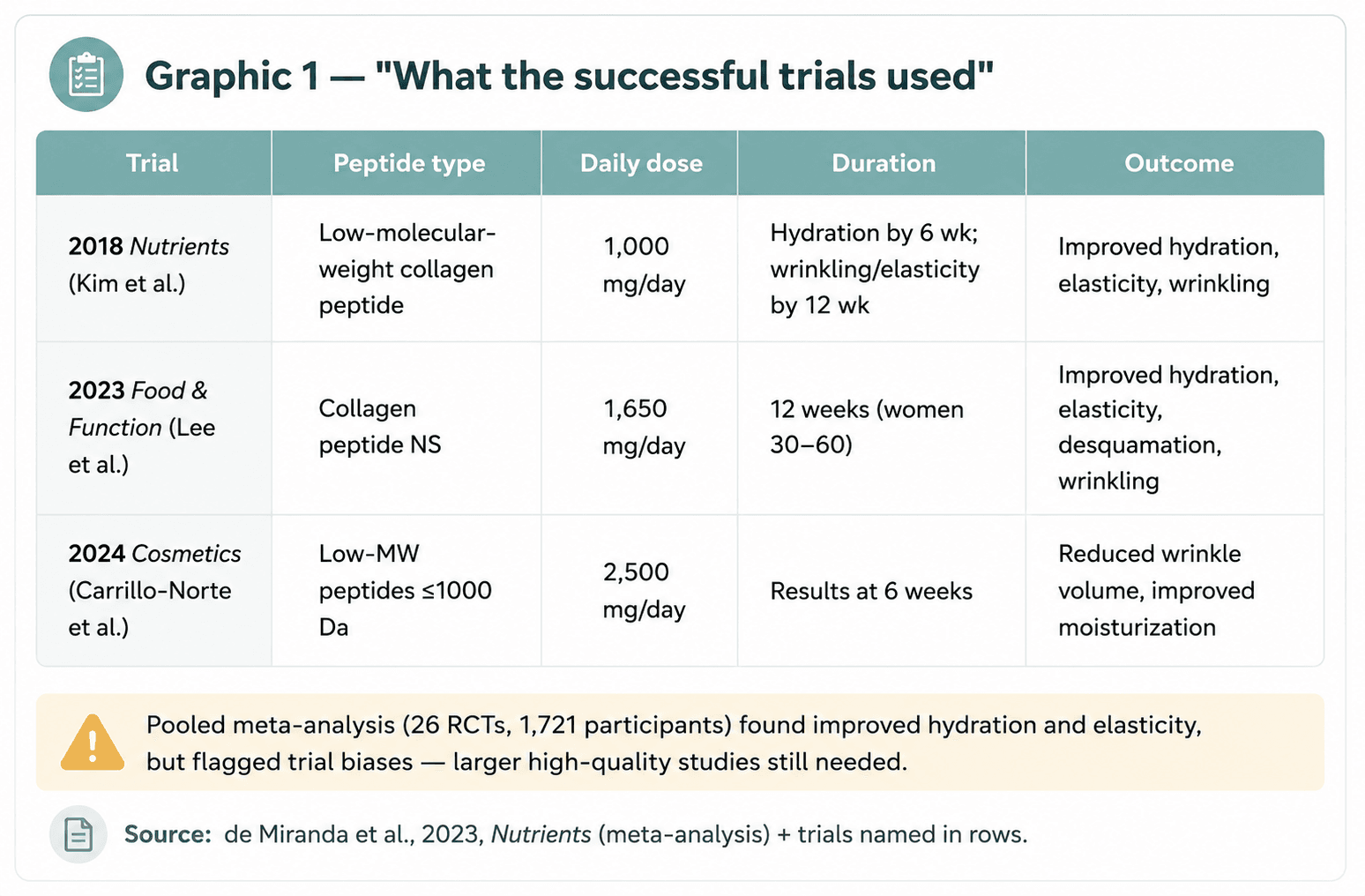
The headline evidence is encouraging. A 2023 systematic review and meta-analysis in Nutrients pooled 26 randomized controlled trials with 1,721 participants and found collagen peptide supplementation significantly improved skin hydration and elasticity versus placebo. That’s a real, pooled signal, with the honest caveat, noted by the authors themselves, that the included trials had several biases and that larger high-quality studies are still needed.
So the goal when evaluating a product is to match it, as closely as you can, to the specific formulations that produced those results. Here’s what that means in practice.
Criterion 1: Molecular Weight
This is the single most important and least-understood spec.
“Collagen” is a large protein. The clinical trials showing skin benefits overwhelmingly used low-molecular-weight collagen peptides, collagen broken down into much smaller fragments. The 2018 RCT in Nutrients that showed improved hydration, elasticity and wrinkling specifically studied low-molecular-weight collagen peptides. A 2024 RCT in Cosmetics used peptides ≤1000 Da and reported reduced wrinkle volume and improved moisturization.
The reason is absorption. A 2026 review in Food, Nutrition and Health explains that molecular size governs how well collagen is absorbed and used, which is exactly why the oral evidence is stronger than the topical evidence (topical collagen struggles to penetrate skin because of its size).
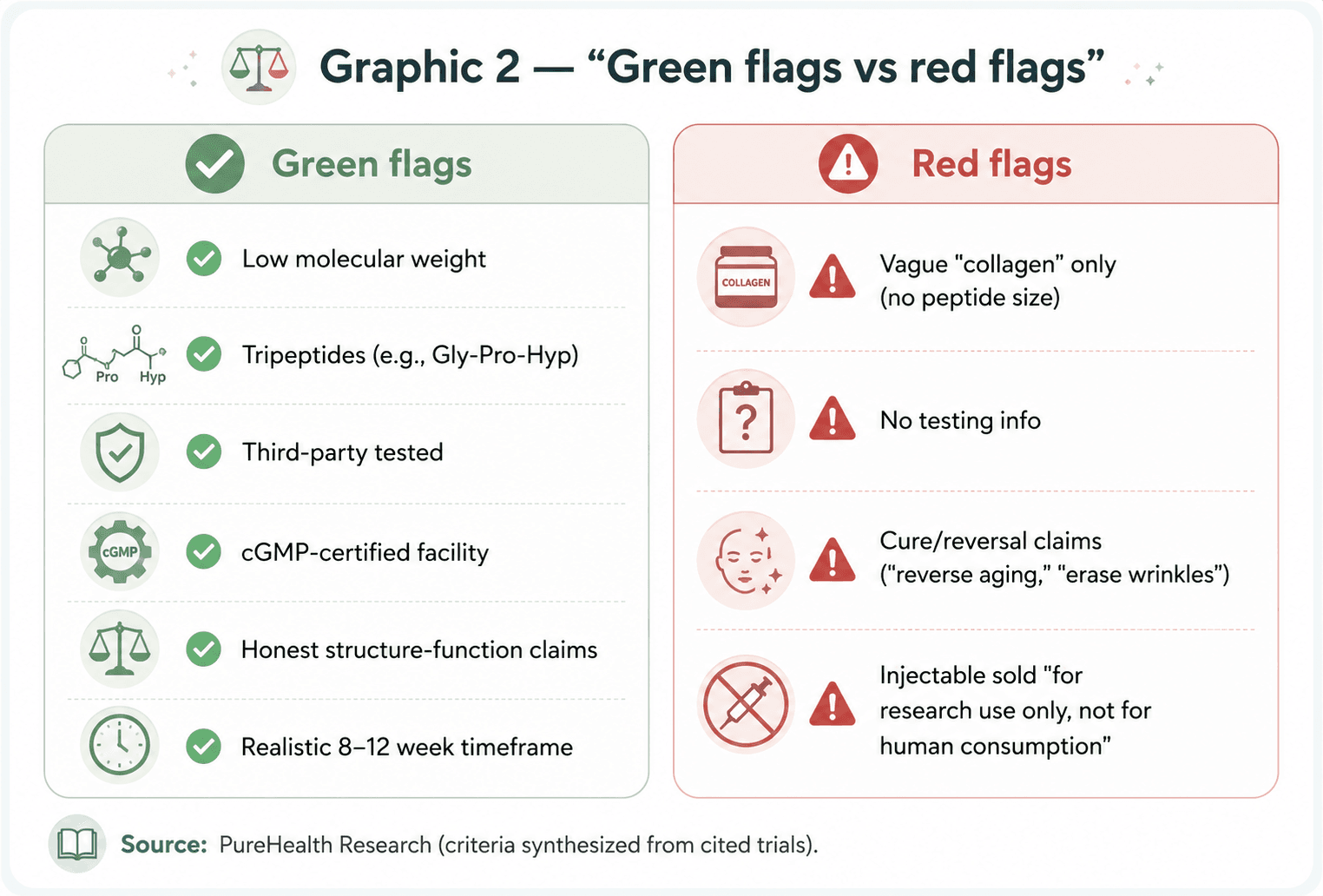
What to look for: language like “low molecular weight,” “hydrolyzed,” or specific tripeptide forms. A product that’s just “collagen” with no indication of peptide size isn’t necessarily bad, but it’s not clearly matching the studied formulations either.
Criterion 2: The Specific Peptides
A step deeper: the absorption research focuses on particular short peptide sequences, not collagen in general.
The 2018 Nutrients trial highlighted tripeptides with a Gly-X-Y structure, including Gly-Pro-Hyp (glycine–proline–hydroxyproline). A 2023 Food & Function RCT focused on dipeptides like Gly-Pro and Pro-Hyp. And a separate 2023 Food & Function study found peptides rich in X-Hyp or X-Hyp-Gly showed resistance to digestive enzymes, meaning they’re more likely to survive intact and reach the bloodstream.
The common thread: hydroxyproline-containing tripeptides appear to be the bioactive forms of interest, because they resist being fully broken down and can act as signals rather than just raw material.
What to look for: products that specify a tripeptide or low-molecular-weight collagen (some branded ingredients are standardized for exactly these fractions) are matching the science more closely than generic collagen.
Criterion 3: Dose And Duration
The successful trials used specific doses over specific timeframes, and knowing them protects you from both underdosing and impatience.
- The 2018 Nutrients RCT : 1,000 mg/day of low-molecular-weight collagen peptide, with hydration improving by 6 weeks and wrinkling/elasticity by 12 weeks.
- The 2023 Food & Function RCT : 1,650 mg/day over 12 weeks in women aged 30–60.
- The 2024 Cosmetics RCT : 2,500 mg/day, with results at 6 weeks.
Two practical lessons. First, doses vary across effective trials, so there isn’t one magic number, but they’re generally in the low grams-per-day range for concentrated low-molecular-weight peptides. Second, and more important: results took weeks to months. Nearly every trial measured benefits at 6–12 weeks. A collagen product isn’t a next-morning fix; if you try one, the evidence says give it a couple of months of consistent use before judging.
Criterion 4: Quality And Third-Party Testing
This criterion isn’t about collagen specifically, it’s about the supplement industry generally, and it’s where a real safety gap lives.
Supplements aren’t regulated as tightly as drugs, so what’s on the label isn’t guaranteed to be what’s in the bottle. Independent, third-party testing for purity, potency and contaminants (like heavy metals) is how a manufacturer demonstrates that its product actually contains what it claims, in the amount claimed, without unwanted extras.
What to look for: third-party testing, manufacturing in a cGMP-certified facility, and transparency about sourcing. These signals don’t make a product work better, but they tell you you’re getting what you paid for and reduce safety risk, which is the baseline before any efficacy question even matters.
Criterion 5: Honest Claims
Here’s a counterintuitive tip: the tone of a product’s marketing is itself information.
The real collagen evidence is genuinely positive but comes with clear limitations, the 2023 meta-analysis explicitly flagged trial biases and called for larger studies. A product that reflects that reality, “supports skin elasticity,” “clinically studied ingredient”, is being straight with you. A product promising to “reverse aging,” “erase wrinkles” or “cure” anything is making claims the science doesn’t support, and that overreach is a reason for more skepticism, not less.
The red flag that matters most: if a “peptide” product is an injectable sold “for research use only, not for human consumption,” it is not a dietary supplement, is not approved for human use, and its safety in people isn’t established. That’s a different and riskier category entirely, covered in our peptides overview, and it shouldn’t be confused with an oral collagen supplement just because both are called “peptides.”
Putting It Together
A well-chosen collagen peptide product, judged by the science, looks like this: a low-molecular-weight or tripeptide form (matching the studied formulations), a sensible daily dose you’ll take consistently for 8–12 weeks, third-party tested and made to quality standards, sold with honest, structure-function claims rather than miracle promises.
That’s exactly the framework behind well-formulated products in this space. PureHealth Research’s Natural Peptides Supplements is built around Morikol® collagen tripeptides, a low-molecular-weight, bioavailable form of the peptide class the trials above studied, third-party tested and made in cGMP-certified facilities, and marketed to support skin, joint and connective-tissue wellness rather than to promise the impossible. Whatever product you choose, running it through these five criteria will tell you far more than the size of the claims on the front of the label.
Conclusion
Evaluating a collagen peptide supplement isn’t guesswork if you let the research set the criteria: molecular weight and peptide form (do they match what was studied?), a realistic dose taken consistently over a couple of months, third-party quality testing, and honest claims. Products that meet those criteria are matching the formulations that produced real clinical results; products that skip them are asking you to trust marketing over evidence. Now you know which questions separate the two.
Match it to what the clinical trials studied: a low-molecular-weight or tripeptide form, a sensible daily dose taken consistently for 8-12 weeks, third-party testing for quality and purity, and honest structure-function claims rather than “miracle” promises.
Yes, it’s one of the most important and overlooked factors. The clinical evidence for skin benefits centers on low-molecular-weight collagen peptides, because smaller peptides are better absorbed. This is also why oral collagen has stronger evidence than topical.
These are specific short collagen peptides the absorption research focuses on. Hydroxyproline-containing tripeptides appear more resistant to being fully broken down in digestion, so more may reach the bloodstream intact, where they’re thought to act as signals supporting collagen-related processes.
Successful trials used roughly 1,000-2,500 mg/day of low-molecular-weight collagen peptides, and, importantly, measured benefits at 6 to 12 weeks. There’s no single magic dose, but consistency over a couple of months matters more than any single day’s amount.
Supplements aren’t regulated as strictly as drugs, so third-party testing is how a manufacturer proves the product actually contains what the label says, at the stated potency, without contaminants like heavy metals. It’s a baseline quality and safety signal.
Not overnight. Nearly every clinical trial measured benefits over 6-12 weeks of consistent daily use. If you try a collagen peptide, give it that timeframe before deciding whether it works for you.
No. Oral collagen peptides are food-derived dietary supplements with real evidence. Injectable peptides sold “for research use only” are not approved for human use, are not supplements, and their safety in people isn’t established. Don’t confuse the two.

Advertisement. This site offers health, wellness, fitness and nutritional information and is designed for educational purposes only. You should not rely on this information as a substitute for, nor does it replace, professional medical advice, diagnosis, or treatment. If you have any concerns or questions about your health, you should always consult with a physician or other health-care professional. Do not disregard, avoid or delay obtaining medical or health related advice from your health-care professional because of something you may have read on this site. The use of any information provided on this site is solely at your own risk.
Related Articles
What Foods Have Peptides? Bioactive Sources Explained
Written by Laura Kraujalyte | October 16, 2026

Oral vs Injectable Peptides: Risks and Trade-Offs
Written by Laura Kraujalyte | October 12, 2026

Do Peptides for Gut Health Actually Work?
Written by Laura Kraujalyte | October 9, 2026

What Are the Best Peptides for Skin?
Written by Laura Kraujalyte | September 30, 2026
Do Peptides for Weight Loss Work?
Written by Laura Kraujalyte | September 16, 2026

Peptides by the Numbers: What the Research Actually Shows
Written by Laura Kraujalyte | July 29, 2026