What Your Liver Blood Tests Actually Mean (Beyond “Normal”)
"Normal" liver test results don't guarantee liver health. A clinical breakdown of what ALT, AST, and other markers actually measure.



 On This Page:
You get a blood panel back, scan the liver section, see everything marked “normal,” and move on. Or you see one value flagged high, feel a jolt of worry, and fall down an internet rabbit hole. Both reactions are common, and both often miss what the numbers are actually saying.
Liver blood tests are genuinely useful, and widely misread, in both directions. Some tests measure injury while others measure function, and those are different questions. “Normal” isn’t always the same as “optimal.” And, this is the part almost nobody knows, normal results don’t guarantee a healthy liver. Here’s what each test actually means, grounded in the clinical literature. Every point links to its source.
Important: this article is educational. It is not a tool for diagnosing yourself. Your own lab’s reference ranges and your doctor’s interpretation of your full picture are what matter, not a number read in isolation.
Injury Vs. Function
The most useful thing to understand before looking at any single value is that liver tests aren’t all asking the same question.
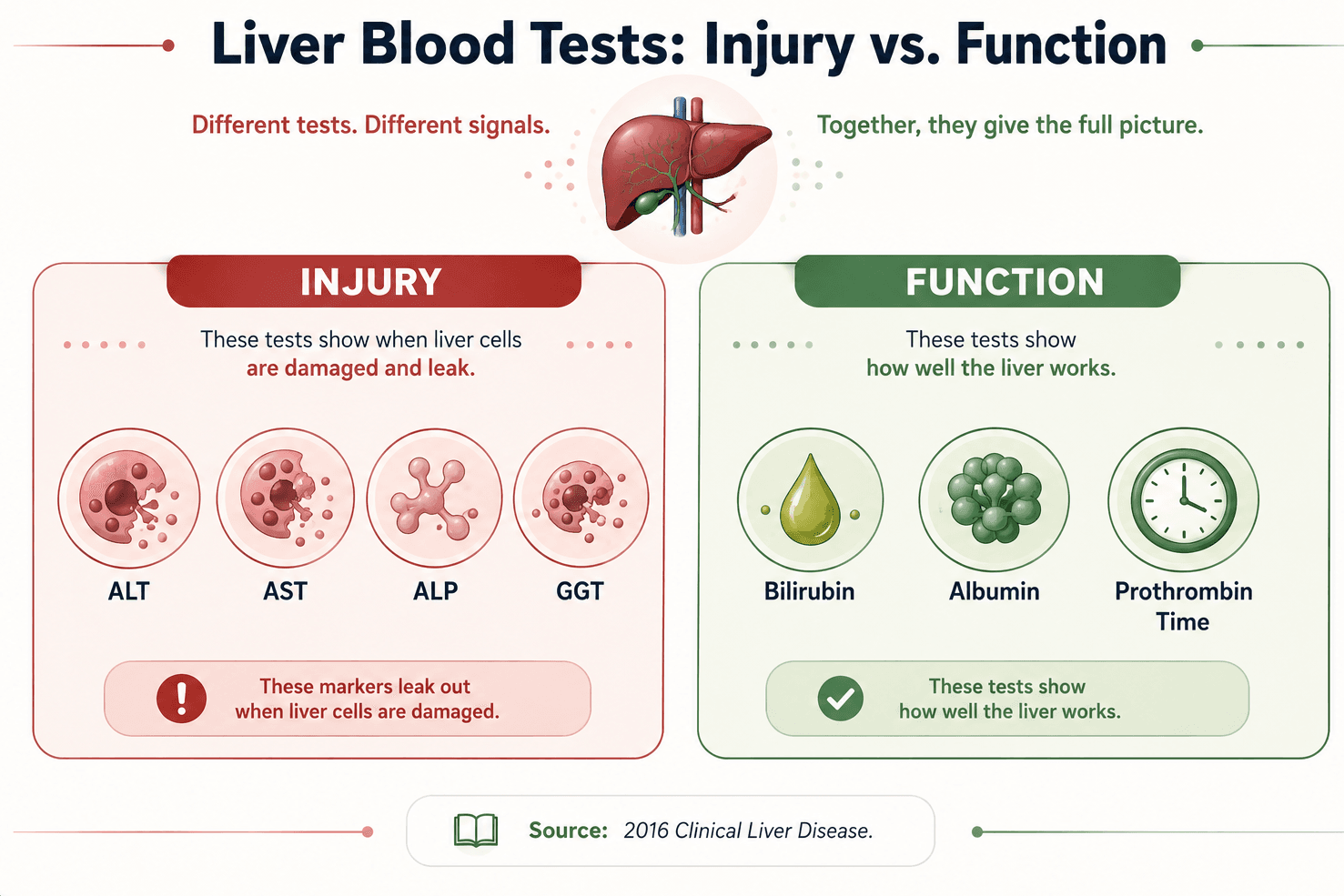
A 2016 review in Clinical Liver Disease draws the distinction cleanly. Some liver tests indicate injury to liver cells or bile ducts, these are the enzymes (ALT, AST, ALP, GGT) that leak into the blood when cells are damaged. Other tests reflect how well the liver is actually functioning, bilirubin, albumin, and prothrombin time (clotting), which show whether the organ is doing its jobs.
This matters because a panel can show enzyme “injury” markers that are elevated while “function” markers stay perfectly normal, meaning some cells are stressed but the organ overall is still doing its work. The reverse can also happen. Reading the two groups as one blurred signal is how people misinterpret their results.
The Injury Markers
ALT (Alanine Aminotransferase)
ALT is the marker most people focus on, and for good reason. As StatPearls (NIH) explains, ALT is largely found inside liver cells and is more liver-specific than AST, so when ALT is elevated, the liver is the most likely source. It’s released into the blood when liver cells are injured or their membranes become more permeable.
One nuance worth knowing: StatPearls notes that enzyme levels reflect a dynamic balance between release from injured tissue and clearance from the blood they’re a signal of what’s happening, not a direct measurement of how much healthy liver tissue you have.
AST (Aspartate Aminotransferase)
AST is where a lot of misreading happens. StatPearls points out that AST is present in many tissues, skeletal muscle, heart, kidney, brain, and red blood cells, not just the liver. So an isolated AST elevation doesn’t automatically mean a liver problem.
A practical example: intense exercise can markedly raise AST (and ALT) from muscle, unrelated to liver function. This is exactly why AST is almost always interpreted alongside ALT rather than alone.
The AST:ALT Ratio
Here’s where combining tests beats reading either one alone. The pattern between AST and ALT can point toward specific causes:
- When AST is roughly twice ALT, the pattern is classically associated with alcohol-related liver injury.
- When both are elevated roughly equally, it more often points toward non-alcoholic causes.
- In chronic liver disease, a rising AST:ALT ratio above 1 can suggest more advanced fibrosis.
The magnitude matters too. Clinical references note that mild elevations are common and often turn up incidentally, while values reaching the thousands of units per liter indicate severe acute injury such as fulminant hepatitis. A number three times the top of normal and a number twenty times it mean very different things.
ALP and GGT
ALP (alkaline phosphatase) and GGT (gamma-glutamyl transferase) tell a different story than ALT and AST. They tend to rise with bile-duct problems rather than liver-cell injury. Because ALP is also found in bone, GGT is often used to confirm that an elevated ALP is coming from the liver/bile system rather than the skeleton, when both are up together, the bile ducts are the likely source.
The Function Markers
Bilirubin
Bilirubin is a waste product the liver processes and clears; when it builds up, it can cause jaundice. But an isolated mildly elevated bilirubin is frequently not a sign of disease.
Gilbert syndrome is the reason. This is an entirely benign inherited variation in how bilirubin is processed, and it’s remarkably common, affecting a meaningful share of the population. People with it may see mildly high bilirubin on a panel, sometimes more so when fasting or unwell, with a perfectly healthy liver. It’s one of the most common causes of a “concerning” liver number that turns out to be nothing to worry about, though only a doctor can confirm that’s what it is.
Albumin And Prothrombin Time
These are the tests that show whether the liver is doing its manufacturing work. Albumin is a protein the liver makes; prothrombin time reflects clotting factors the liver produces. Low albumin or prolonged clotting time can indicate the liver’s function is genuinely impaired, which is different from, and often more meaningful than, a modestly elevated enzyme. These tend to shift in more established liver disease rather than early, mild issues.
“Normal” And “Optimal”
Here’s a subtlety that surprises people: the reference range on your lab report isn’t a line between “healthy” and “diseased.”
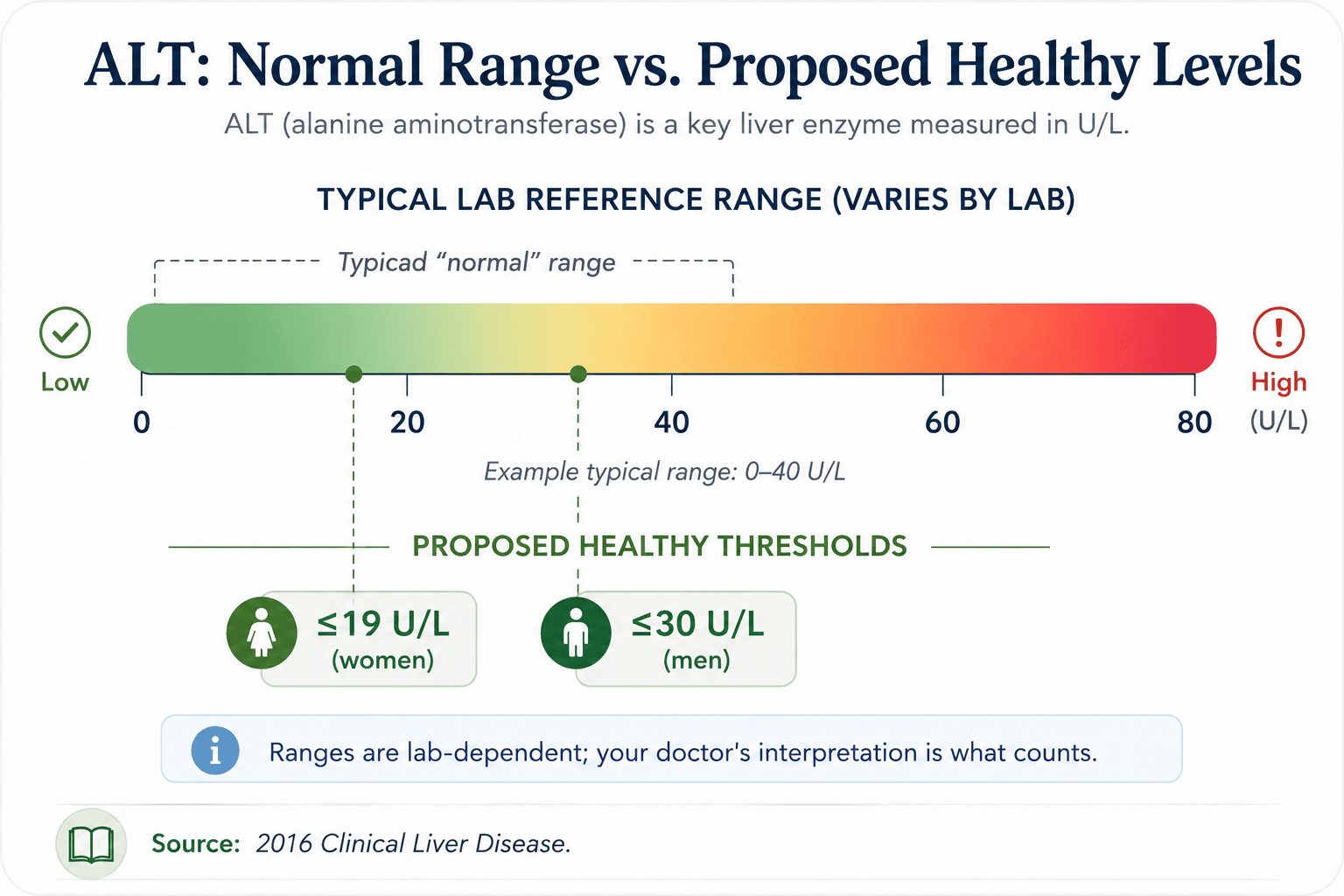
Research discussed in the 2016 Clinical Liver Disease review has proposed healthy ALT limits, on the order of ≤19 U/L for women and ≤30 U/L for men, that sit below many standard laboratory reference ranges. In other words, a value your lab prints as “normal” might still be higher than the level associated with the healthiest livers.
This doesn’t mean you should panic over a technically-normal result, and it absolutely doesn’t mean self-diagnosing from a chart. It means the “normal/abnormal” flag on a lab report is a blunt instrument, and the trend in your own numbers over time, interpreted by your doctor, is often more informative than a single in-range or out-of-range mark.
Normal Tests Don’t Guarantee A Healthy Liver
If you take one thing from this article, make it this.
Normal liver blood tests are reassuring, but they are not proof of a healthy liver. The liver is a “silent” organ that can be significantly affected while standard tests look fine. A striking illustration comes from a 2017 multicenter study in The Journal of Thoracic and Cardiovascular Surgery: in a specialized patient group, routine blood tests and imaging did not reliably reflect the degree of fibrosis found on biopsy, all 68 evaluable biopsies were abnormal, with sinusoidal fibrosis in 97%, despite tests that didn’t fully capture it.
That’s a specific population, but the principle generalizes and is well recognized clinically: liver blood tests are a valuable screening signal, not a complete picture. Early fatty liver in particular can be present with normal or only mildly abnormal enzymes. This is exactly why “my liver tests were normal, so I don’t need to think about it” is a mistake, and why overall metabolic health, weight and lifestyle matter regardless of what a single panel shows.
What To Actually Do With Your Results
The honest, safe guidance is short: don’t self-diagnose from numbers, and don’t ignore them either.
- If a result is flagged, ask your doctor what the pattern suggests, whether it should be rechecked (mild elevations often are, since they can be transient), and whether anything, exercise before the test, a medication, alcohol, a viral illness, could explain it.
- If everything’s normal but you have risk factors (weight, diabetes, family history, alcohol use), remember that normal tests don’t rule out early issues, and discuss whether further assessment makes sense.
- Track the trend over time rather than fixating on one reading.
Interpreting liver tests properly means combining several values, your history, and often further testing, which is a doctor’s job, not a chart’s.
Supporting Healthy Liver Function Day To Day
Blood tests measure your liver; they don’t improve it. What supports the organ is the same unglamorous, well-evidenced set of habits: a balanced diet without excess calories, a healthy weight, regular movement, a stable sleep and eating rhythm, moderate alcohol, and care with medications and unproven herbal products. These are the levers with real evidence behind them, the research showing a 5% BMI reduction linked to roughly a 25% reduction in liver fat is a good example.
Some people add nutritional support to that foundation. PureHealth Research’s Supplements for Liver Health feature studied botanicals like milk thistle (standardized for silymarin) and turmeric, formulated to support normal liver function and antioxidant defense as part of a healthy routine. To be clear about what that is and isn’t: supplements are lifestyle support, not a way to change your blood test results, and they don’t replace medical evaluation of an abnormal result. If a test is flagged, that’s a conversation for your doctor.

Conclusion
Liver blood tests are more informative, and more limited, than most people realize. They separate into injury and function markers; ALT is the liver-specific workhorse while AST needs context; ratios and patterns often say more than single values; “normal” isn’t always “optimal”; and, most importantly, normal results don’t guarantee a healthy liver. Understanding that turns a confusing row of numbers into a useful conversation with your doctor, which is exactly where the interpreting should happen.
Two different things. Injury markers (ALT, AST, ALP, GGT) are enzymes that leak into the blood when liver or bile-duct cells are damaged. Function markers (bilirubin, albumin, prothrombin time) show how well the liver is doing its jobs. They answer different questions and are best read together.
ALT is largely liver-specific, so an elevation points fairly reliably to the liver. AST is found in many tissues, muscle, heart, kidney, red blood cells, so an isolated AST rise can come from outside the liver. That’s why they’re interpreted together, often as a ratio.
Not necessarily. Proposed healthy ALT limits sit below many lab reference ranges, so “normal” isn’t always “optimal.” More importantly, normal tests don’t rule out liver disease, the liver can be affected while standard tests look fine.
Yes. The liver is a “silent” organ, and early issues like fatty liver can be present with normal or only mildly abnormal enzymes. One study found routine tests didn’t reliably reflect fibrosis seen on biopsy. Liver tests are a screening signal, not a complete picture.
A common reason is Gilbert syndrome, a benign, inherited variation in bilirubin processing that affects a meaningful share of people. It can cause mildly elevated bilirubin, sometimes when fasting or unwell, with a healthy liver. Only a doctor can confirm that’s the cause.
You shouldn’t self-manage based on numbers. If a result is flagged, the right step is to ask your doctor what the pattern means, whether it should be rechecked, and what might explain it. Supplements don’t “lower” liver enzymes, and an abnormal result needs proper evaluation.
The pattern can hint at causes. AST roughly double ALT is classically linked to alcohol-related injury; roughly equal elevations point more toward non-alcoholic causes; and a ratio above 1 in chronic disease can suggest more advanced fibrosis. It’s one clue among many that a doctor weighs together.

Advertisement. This site offers health, wellness, fitness and nutritional information and is designed for educational purposes only. You should not rely on this information as a substitute for, nor does it replace, professional medical advice, diagnosis, or treatment. If you have any concerns or questions about your health, you should always consult with a physician or other health-care professional. Do not disregard, avoid or delay obtaining medical or health related advice from your health-care professional because of something you may have read on this site. The use of any information provided on this site is solely at your own risk.
Related Articles
7 Signs of Liver Detox Working
Written by Karolina Rutkute | September 23, 2026

How to Make Your Liver Healthy Again: The Complete 7-Step Guide
Written by Karolina Rutkute | August 5, 2026

Liver Health by the Numbers: What the Research Actually Shows
Written by Laura Kraujalyte | July 29, 2026

Can Stress Cause Elevated Liver Enzymes?
Written by Karolina Rutkute | May 7, 2026

What is the Function of the Liver? 5 Essential Roles Explained
Written by Karolina Rutkute | May 2, 2026
Liver Detox Symptoms: Signs, Timelines, and What to Expect
Written by Karolina Rutkute | April 30, 2026