Liver Health by the Numbers: What the Research Actually Shows
The liver runs 85% of your body's methylation chemistry and can regenerate itself. Peer-reviewed data on how it actually works.



 On This Page:
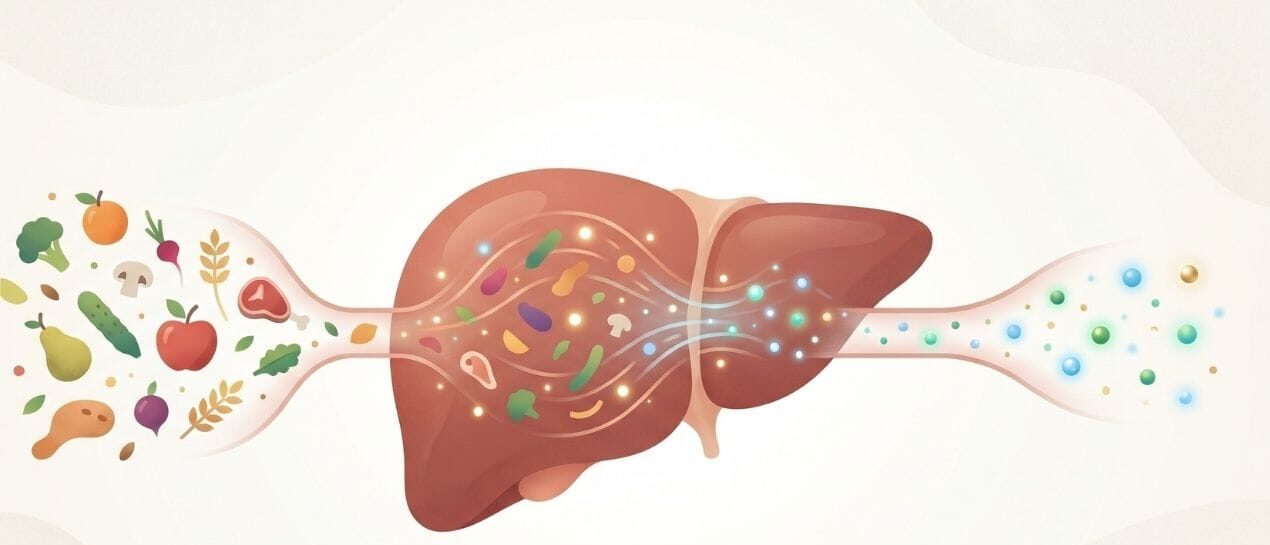
The liver is the organ people worry about vaguely and understand specifically almost never. It gets called a filter, which is roughly like calling a smartphone a clock, technically true, wildly incomplete.
Here’s a more accurate picture, assembled from peer-reviewed research: an organ that performs the majority of your body’s methylation chemistry, runs on a 24-hour internal clock, holds a running conversation with your gut microbiome, and can regenerate after losing most of its mass. It’s also an organ where the single most evidence-backed intervention isn’t a supplement or a cleanse, it’s something considerably more boring.
What The Liver Actually Does, In Numbers
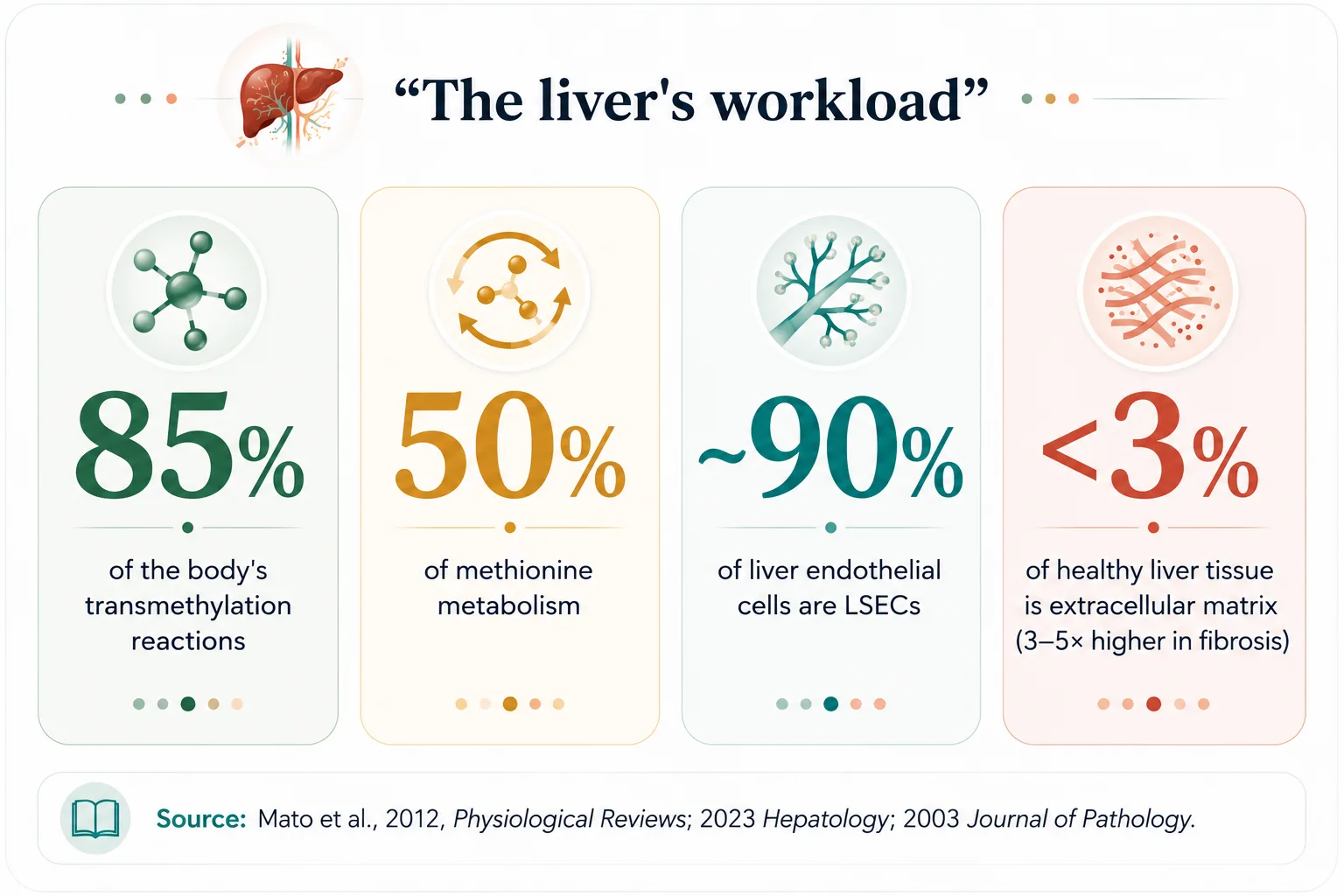
Start with the workload. A 2012 review in Physiological Reviews on S-adenosylmethionine, the liver’s principal methyl donor, reports that the liver carries out approximately 85% of all transmethylation reactions in the body and 50% of methionine metabolism. Methylation regulates gene expression, builds neurotransmitters, and supports glutathione production. Most of it happens in one organ.
It’s not a uniform organ, either. A 2023 review in Hepatology notes that liver sinusoidal endothelial cells, the specialized cells lining the liver’s blood channels, account for roughly 90% of all liver endothelial cells, and that their dysfunction contributes to inflammation, fibrosis and impaired regeneration. Liver health, in other words, depends on the liver’s blood vessels, not only its hepatocytes.
Add the immune layer. A 2022 review in Immunity describes multiple distinct macrophage populations in the liver, identified through single-cell mapping, handling immune surveillance, iron recycling, lipid processing and tissue repair, with a conserved Kupffer cell signature found across seven species.
And there’s a recycling system running underneath all of it. A 2017 review in Nature Reviews Gastroenterology & Hepatology describes hepatic autophagy, the process by which liver cells break down and reuse damaged proteins and organelles, as essential to energy metabolism, lipid regulation and hepatocyte maintenance, with impaired autophagy linked to fatty liver disease and other conditions.
A 2003 review in The Journal of Pathology adds one number worth holding onto: in a healthy liver, extracellular matrix, structural scaffolding, occupies less than 3% of liver tissue. In a fibrotic liver, it’s three to five times higher.
How To Measure “Liver Health”
For decades, liver health meant one thing: no diagnosed liver disease. A 2025 paper in Gastroenterology argues that definition is far too crude, and proposes a measurable alternative built across 10 components in 5 dimensions, covering health behaviors, metabolic health, liver blood tests, and absence of fibrosis, not simply absence of diagnosis.
The framework comes with a striking validation figure. A LiverRisk score below 6 was associated with only a 0.56% likelihood of liver fibrosis and less than 0.1% liver-related mortality over 12 years.
The context for why this matters is in the burden data. The same paper notes that liver diseases cause more than 2 million deaths annually, roughly 4% of all global deaths. A 2014 analysis in BMC Medicine breaks that down further: cirrhosis alone caused just over 1 million deaths in 2010, around 2% of global deaths, with approximately another million from liver cancer and acute hepatitis. That analysis also flags a data problem, 58 of 187 countries (31%) had no usable cirrhosis mortality observations at all.
The consequences aren’t only mortality. A 2001 study in the American Journal of Gastroenterology following 353 patients found quality of life in chronic liver disease was lower than the general population and comparable to people living with COPD or congestive heart failure, regardless of which liver condition was involved. The liver–body connection runs further still: a 2020 review in the Journal of Clinical Densitometry reports osteoporosis prevalence close to 30% in primary biliary cholangitis.
This section is educational context about population-level liver disease. If you have concerns about your own liver health, ask your doctor about appropriate testing.
What Liver Blood Tests Tell You
This is the section most people get wrong, and it’s genuinely useful to get right.
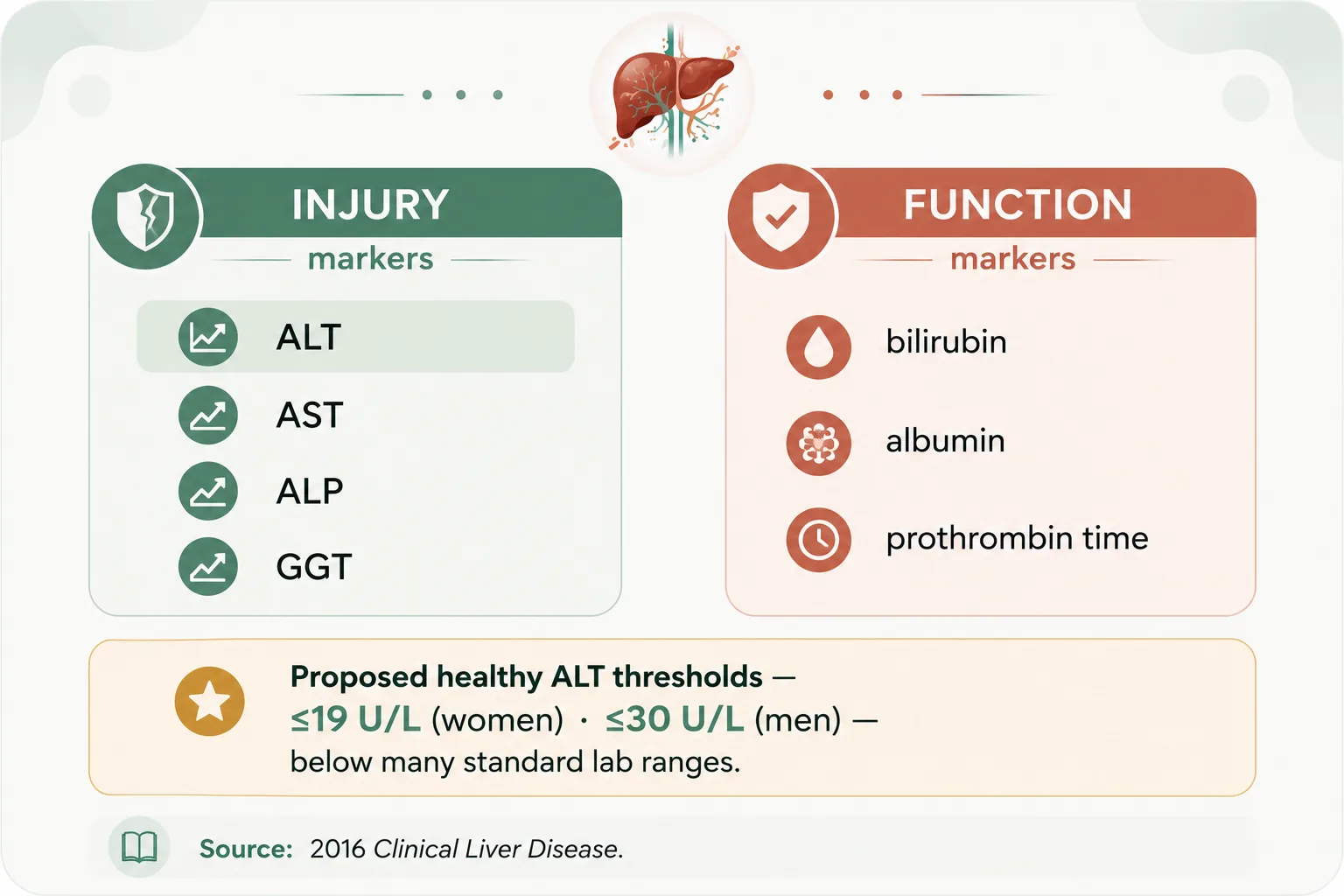
A 2016 review in Clinical Liver Disease makes a distinction that rarely survives the trip from lab report to patient: liver tests do not all measure the same thing. ALT, AST and alkaline phosphatase mainly indicate injury to liver cells or bile ducts. Bilirubin, albumin and prothrombin time reflect how well the liver is actually functioning. Injury and function are different questions.
The numbers worth knowing:
| Measure | What the research reports |
| Proposed healthy ALT limit | ≤19 U/L (women), ≤30 U/L (men), lower than many lab reference ranges |
| Mild abnormalities in asymptomatic people | 1–4% |
| Gilbert syndrome (benign bilirubin variant) | Up to 5% of the population |
| AST/ALT ratio ~2:1 | Commonly associated with alcohol-related hepatitis |
| AST/ALT ratio >1 in chronic liver disease | May suggest advanced fibrosis |
Two things follow. First, “normal” on a lab report isn’t necessarily optimal, the proposed healthy ALT thresholds sit below many standard ranges. Second, normal tests don’t guarantee a healthy liver. A 2017 multicenter study in The Journal of Thoracic and Cardiovascular Surgery examined 241 adults with Fontan circulation and found that routine blood tests and imaging did not reliably reflect the fibrosis seen on biopsy, all 68 evaluable biopsies were abnormal, with sinusoidal fibrosis in 97%.
That’s a specialized population, but the principle generalizes: liver blood tests are a useful signal, not a complete picture.
Liver Timing And Gut Connection
Two research areas have reshaped how liver health is understood, and both are about timing and context rather than the organ in isolation.
The clock. A 2019 review in the Journal of Hepatology, drawing on 142 references, describes the liver operating on a 24-hour circadian rhythm that regulates nutrient uptake, glucose and lipid metabolism, detoxification and energy balance. Disrupting that clock, through shift work, jet lag, irregular sleep or inconsistent eating times, can impair those processes, and the authors identify circadian misalignment as a contributor to metabolic dysfunction and chronic liver disease.
Put plainly: when you eat and sleep appears to matter to the liver, not only what you eat.
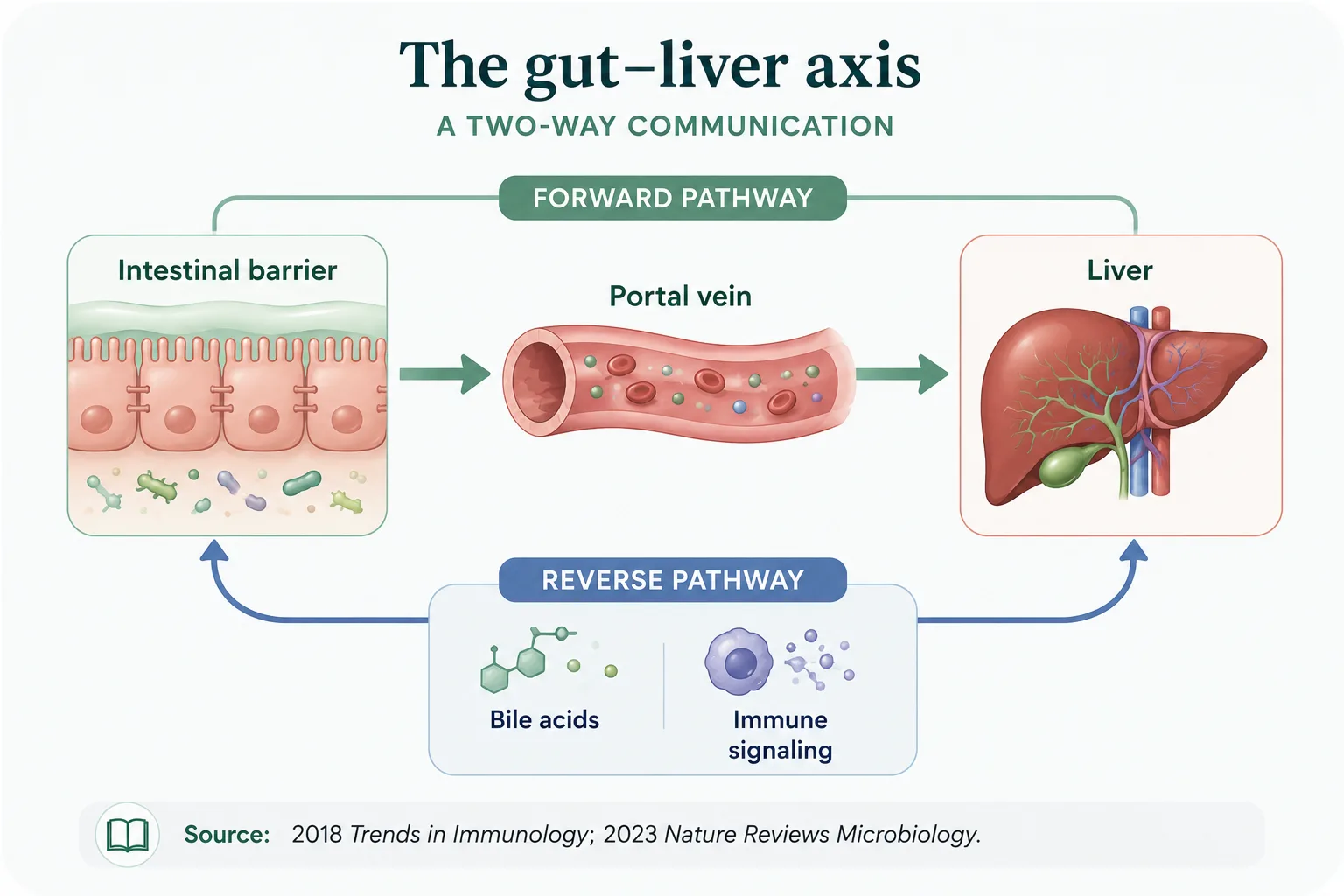
The gut. A 2018 review in Trends in Immunology describes two-way communication along the gut–liver axis, with changes in the intestinal microbiome associated with several liver conditions. A 2023 review in Nature Reviews Microbiology develops the mechanism: high-fat diets and excessive alcohol can disrupt the microbiome, weaken the intestinal barrier, and allow microbial products to reach the liver, while gut microbe-derived metabolites influence liver function in turn.
The liver, in other words, is downstream of your gut in a literal anatomical sense. Everything absorbed from the intestine reaches it first.
The Most Evidence-Backed Lever
If you rank liver interventions by strength of human evidence, the top of the list is unromantic.
A 2016 review in Hepatology on diet, weight loss and fatty liver reports a clear dose–response relationship:
- 5% reduction in BMI → roughly 25% reduction in liver fat
- 7–10% weight loss → reduced liver fat and disease remission
- ≥10% body weight lost → resolution in 90% of participants in one study, with 45% showing fibrosis regression
- After bariatric surgery → around 85% achieved resolution at one year
The same review identifies Mediterranean-style eating and regular physical activity as supportive, and high intake of industrial fructose and saturated fat as contributors to liver fat and inflammation.
That fructose point deserves nuance, because it’s widely overstated. A 2014 systematic review and meta-analysis in the American Journal of Clinical Nutrition covering 27 studies (6 observational, 21 intervention) concluded that the available human evidence does not support fructose, high-fructose corn syrup or sucrose independently causing fatty liver. The relationship appeared largely explained by excess calories rather than fructose itself.
A 2017 review in Digestive Diseases makes a related and often-missed point: both nutrient excess and severe malnutrition can produce fatty liver. Liver dysfunction occurs at both extremes of nutrition, which is an argument for balance rather than restriction.
On antioxidants, a 2015 review in the World Journal of Gastroenterology surveyed food-derived compounds including silymarin, curcumin, quercetin, resveratrol, green tea compounds and coffee. It ranked silymarin as having the strongest potential hepatoprotective antioxidant profile, while noting explicitly that the strength of human evidence varies by compound. The same review cites an observational study in which cirrhosis odds ratios declined from 1.0 in non-coffee-drinkers to 0.47, 0.23, 0.21 and 0.16 with one, two, three and four daily cups respectively. Observational data, so association rather than proof, but a consistent one.
A 2019 review in Antioxidants found higher serum carotenoids associated with improved fatty-liver indicators in a study of 3,336 adults, though its more dramatic figures come from animal work and shouldn’t be read as human outcomes.
The Liver’s Most Underrated Quality:
One finding runs through this literature and rarely makes it into consumer content: liver damage is not automatically a one-way street.
The 2003 Journal of Pathology review describes fibrosis as a dynamic process, one that can slow, stabilize or even partially regress when the underlying cause of injury is removed or successfully treated. The same review notes the liver’s regenerative capacity is substantial enough that recovery is possible even after more than 80% of liver cells have been destroyed, provided the injury is acute and the damaging factor is eliminated.
That’s the practical argument for paying attention early. Not because damage is irreversible, but because the liver responds when the load comes off.
Supporting Healthy Liver Function Day To Day
The research points consistently in the same direction: a balanced diet without excess calories, a stable eating and sleeping rhythm, regular movement, moderate alcohol intake, attention to gut health, and periodic blood testing so you have a baseline rather than a guess.
For a practical routine, see our guides on ways to improve liver function and supporting liver health day to day.
Some people also choose to add targeted nutritional support alongside those habits. PureHealth Research’s Supplements for Liver Health feature botanicals including milk thistle (standardized for silymarin), turmeric, dandelion and artichoke, formulated to support normal liver function and antioxidant defense as part of a balanced routine, not as a replacement for the dietary and lifestyle factors the research supports most strongly.

Conclusion
The liver runs most of your body’s methylation chemistry, keeps its own 24-hour clock, responds to your gut microbiome, and can recover from remarkable amounts of damage when the cause is removed. Liver health is measurable, and the intervention with the strongest human evidence behind it remains weight, diet and daily rhythm, not any single ingredient.
The good news buried in the data: a 5% shift in body weight moved liver fat by roughly 25%. Small changes register in this organ.
Far more than filtering. Research in Physiological Reviews reports the liver performs approximately 85% of the body’s transmethylation reactions and 50% of methionine metabolism, alongside bile production, glucose and lipid regulation, protein synthesis, nutrient storage and immune functions.
A 2016 review in Clinical Liver Disease reports proposed healthy limits of ≤19 U/L for women and ≤30 U/L for men, lower than many standard laboratory reference ranges. Interpretation depends on the full test panel and individual context, so discuss results with your doctor.
Yes. A 2017 multicenter study found that routine blood tests and imaging did not reliably reflect the degree of fibrosis found on biopsy in a specialized patient population. Liver tests are a signal, not a complete picture.
Research suggests it does. A 2019 Journal of Hepatology review describes the liver operating on a 24-hour circadian rhythm governing metabolism and detoxification, and identifies shift work, jet lag and irregular eating schedules as contributors to metabolic dysfunction.
A 2016 Hepatology review reports that a 5% reduction in BMI was linked to roughly a 25% reduction in liver fat, with 7–10% weight loss associated with broader improvement.
The evidence is weaker than commonly claimed. A 2014 meta-analysis of 27 studies found the relationship between sugar intake and fatty liver appeared largely explained by excess calories rather than fructose specifically.
Yes. Reviews in Trends in Immunology and Nature Reviews Microbiologydescribe two-way communication along the gut–liver axis, where a disrupted microbiome and weakened intestinal barrier allow microbial products to reach the liver.
Research in The Journal of Pathology describes fibrosis as a dynamic process that can slow, stabilize or partially regress when the underlying cause is removed or treated. The liver also has substantial regenerative capacity. This depends heavily on the cause and stage, and requires medical assessment.

Advertisement. This site offers health, wellness, fitness and nutritional information and is designed for educational purposes only. You should not rely on this information as a substitute for, nor does it replace, professional medical advice, diagnosis, or treatment. If you have any concerns or questions about your health, you should always consult with a physician or other health-care professional. Do not disregard, avoid or delay obtaining medical or health related advice from your health-care professional because of something you may have read on this site. The use of any information provided on this site is solely at your own risk.
Related Articles
7 Signs of Liver Detox Working
Written by Karolina Rutkute | September 23, 2026

How to Make Your Liver Healthy Again: The Complete 7-Step Guide
Written by Karolina Rutkute | August 5, 2026

What Your Liver Blood Tests Actually Mean (Beyond “Normal”)
Written by Laura Kraujalyte | July 29, 2026

Can Stress Cause Elevated Liver Enzymes?
Written by Karolina Rutkute | May 7, 2026

What is the Function of the Liver? 5 Essential Roles Explained
Written by Karolina Rutkute | May 2, 2026
Liver Detox Symptoms: Signs, Timelines, and What to Expect
Written by Karolina Rutkute | April 30, 2026