Can You Drink Kombucha Every Day or Is It Too Much?
Most healthy adults can enjoy kombucha daily in moderation. Here's how much is reasonable, what daily servings add up to, and when to cut back.



 On This Page:
Can you drink kombucha every day? For most healthy adults, yes, in moderate amounts. What counts as moderate depends on the sugar, caffeine, trace alcohol, and acidity in each bottle, along with how your stomach responds.
There’s no official daily intake, and the 4-ounce figure often repeated online comes from a 1995 CDC report that is frequently misquoted. This guide covers how much is reasonable, what daily kombucha may do, the signs you’re having too much, who should limit it, and how to make the habit work.
Is It Safe to Drink Kombucha Every Day?
For most healthy adults, drinking a moderate amount of store-bought kombucha every day is generally considered safe. There’s no official daily intake, so the practical limits come from its sugar, caffeine, trace alcohol, and acidity, and from how your body responds.
Two points shape that answer:
- Store-bought vs. homemade. Commercial kombucha is made under controlled conditions and must stay below 0.5% alcohol. The CDC notes that home-brewed tea can become contaminated and shouldn’t be brewed or stored in ceramic or lead-crystal containers.
- Rare serious reactions. Memorial Sloan Kettering lists rare case reports, such as lactic acidosis and liver problems, mostly linked to home-brewed kombucha.
So can you drink kombucha every day despite these reports? For a healthy adult choosing a commercial brand and keeping portions sensible, yes, though they are a good reason to favor store-bought bottles.
How Much Kombucha Per Day Is Reasonable?
There’s no established daily intake for kombucha. No official body has set a recommended amount or an upper limit, and the figure most articles cite is a cautious observation from 1995, not a recommendation.
In practice, a reasonable amount is one your body tolerates and that keeps sugar and caffeine within your usual daily range. For most people, that falls somewhere between a small glass and a single bottle, adjusted to the product’s label and your own response.
What the 4-Ounce Figure Actually Means
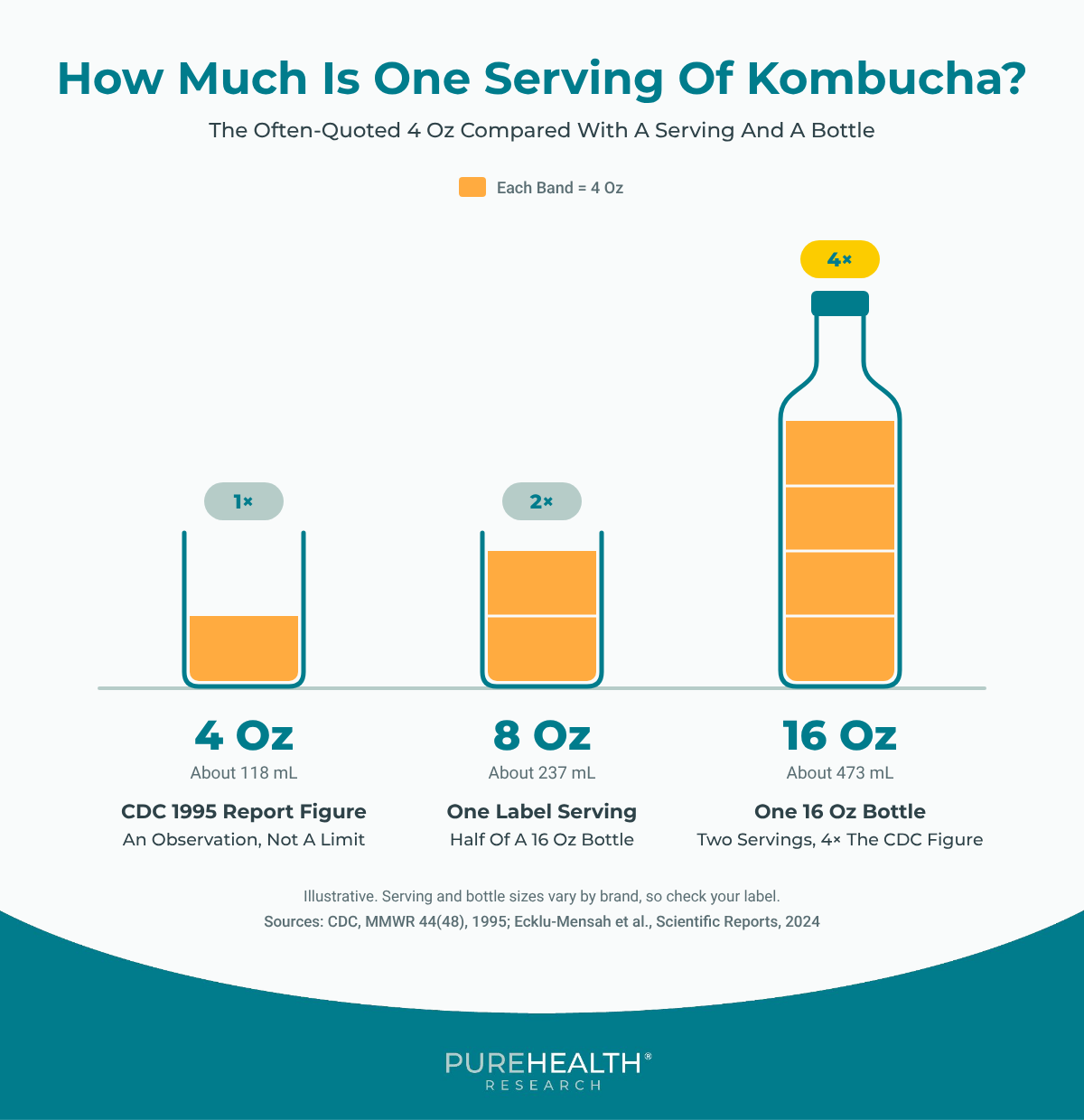
The CDC’s 1995 report stated that drinking about 4 oz daily “may not cause adverse effects in healthy persons”. It came from an investigation into two cases of illness in Iowa, and it described what people typically drank rather than setting a recommended or maximum intake.
Many articles still present it as an official guideline. For a closer look at what the evidence does and doesn’t show, see is kombucha actually good for you. A standard bottle holds 14 to 16 oz, or three to four of those servings.
How Often Should You Drink Kombucha?
So can you drink kombucha every day without discomfort? Daily is fine for most healthy adults who tolerate it, and pace matters more than frequency:
- Start with a small glass of 4 to 8 oz and see how you feel over a week or two before working up.
- A full bottle in one sitting is where most stomach complaints tend to start.
- Splitting a bottle across the day, or across two days, keeps each serving modest.
In a 2024 randomized trial, healthy adults drank 16 oz daily for four weeks without significant changes in inflammation or other blood markers. The study was small, with 24 participants, so read it as reassurance rather than a target.
Table 1: What Daily Kombucha Adds Up To
| Daily amount | Approximate sugar | Approximate caffeine | Notes |
| 4 oz (small glass) | About 4 g | About 3–12 mg | The CDC report’s figure |
| 8 oz (one serving) | About 8 g | About 5–25 mg | A common label serving |
| 16 oz (one standard bottle) | About 15 g | About 10–50 mg | Three to four times the CDC figure |
| 32 oz (two bottles) | About 30 g | About 20–100 mg | Sugar adds up quickly |
Approximate. Brands vary widely, so check your label. Sugar estimates use an average of 3.2 g per 100 mL across commercial products, and caffeine estimates scale brand-reported values of 8 to 25 mg per 8 to 12 oz serving.
What Happens When You Drink Kombucha Daily
The effects of drinking kombucha daily are usually modest, and they depend on the product and the person. Human research is still limited: a 2019 systematic review found only one human study on kombucha’s health effects at the time, and most newer trials remain small.
That means the points below describe what may happen for some people, not what will happen for everyone. They cover digestion, early side effects, energy, sugar intake, and antioxidants.
Your Gut and Digestion
Kombucha’s live cultures may support a healthy balance of gut bacteria. In the 2024 trial, four weeks of daily kombucha led to modest shifts in gut bacteria, including more of a probiotic strain found in the drink itself.
Our guide to kombucha for digestion covers this in more detail. A small 2023 pilot also linked a kombucha drink fortified with inulin and vitamins to better regularity over 10 days, though the added fiber makes it hard to credit kombucha alone.
Bloating and Gas, Especially at First
Carbonation, live cultures, and fermentable sugars can all cause gas, especially in the first week or two or after a full bottle. Reactions vary widely, so one person may feel nothing while another notices bloating within an hour.
Our article on whether kombucha helps with bloating explains why the same drink can affect people so differently. Smaller servings taken with food are often easier to tolerate.
Energy and Caffeine
A daily bottle adds a small amount of caffeine from its tea base, usually far less than a cup of coffee. Some people notice this as a mild lift, while others feel no change at all.
You can check typical amounts in our breakdown of how much caffeine kombucha has and read more about whether kombucha gives you energy. Table 1 shows how caffeine adds up across servings.
Weight and Sugar Swaps
There’s no human evidence that kombucha itself causes weight loss. The more practical effect comes from what it replaces: swapping a daily soda or juice for a lower-sugar kombucha can cut added sugar.
Our review of kombucha for weight loss looks at this in more depth. Adding a sugary kombucha on top of your usual drinks, however, can raise your daily sugar intake instead.
Antioxidants From Tea
Kombucha keeps polyphenols from its tea base, and fermentation may change their form and amount. This is its best-supported benefit, since tea polyphenols are well studied as antioxidants.
Levels vary with the tea used, the brewing time, and any added juice. Plain brewed tea offers much of the same, so kombucha is one option among several rather than a unique source.
Signs You’re Drinking Too Much Kombucha
Your body usually gives clear signals when your intake is more than it handles well. These are the most common ones to watch for:
- Ongoing gas, bloating, or stomach cramps
- Heartburn or a burning feeling after drinking
- Nausea or an upset stomach, especially on an empty stomach
- Jitters, a racing heart, or trouble sleeping if you’re sensitive to caffeine
- Tooth sensitivity, since kombucha’s pH of roughly 2.5 to 4.2 can wear enamel with frequent sipping, according to lab research
- Daily added sugar creeping up without your noticing
If any of these show up, cut back to a smaller serving, have it with food, or take a break for a few days. Seek medical care for severe or persistent symptoms such as vomiting, yellowing skin, or confusion, which appear in rare case reports.
Who Should Limit or Skip Daily Kombucha
Kombucha suits most adults, but some groups have good reason to check with a healthcare provider before making it a daily habit.
Table 2: Who Should Check Before Drinking Kombucha Daily
| Group | Why it matters | What to do |
| Pregnant or breastfeeding | Trace alcohol, caffeine, and live cultures in raw kombucha | Talk with your healthcare provider first |
| Children | Trace alcohol, caffeine, and acidity | Ask your child’s healthcare provider |
| Weakened immune system | Raw, unpasteurized products carry contamination risk | Check with your healthcare provider; consider pasteurized options |
| Liver or kidney concerns | Rare case reports of liver problems and acidosis | Check with your healthcare provider |
| Avoiding alcohol or in recovery | Regular kombucha contains under 0.5% ABV, and levels can vary | Check labels, or choose a non-fermented option |
| Taking medications sensitive to stomach acidity | Kombucha’s acidity may affect how some drugs are absorbed | Ask your pharmacist |
| Sensitive digestion, FODMAP sensitivity, or reflux | Carbonation, acidity, and fermentable sugars can trigger symptoms | Start small, or skip it if symptoms flare |
How to Make Drinking Kombucha Everyday Work for You
A few simple habits make drinking kombucha everyday easier on your stomach, your teeth, and your sugar intake:
- Start with 4 to 8 oz and increase slowly over a couple of weeks.
- Have it with or after a meal if your stomach is sensitive.
- Drink plain water alongside it, not in place of it.
- Compare added sugars on the label. Food Network’s dietitian suggests options with less than 12 g of added sugar per serving, and our guide explains how to read a kombucha label.
- Keep bottles refrigerated and check the dates. Our guide on how to store kombucha covers shelf life and signs of spoilage.
- Finish your serving in one sitting rather than sipping for hours, then rinse with water to limit acid contact with your teeth.
- If you home-brew, use glass, keep tools clean, and avoid ceramic or lead-crystal containers.
- Have your last serving earlier in the day if caffeine affects your sleep.
If keeping a fridge full of bottles makes a daily habit hard to stick with, gut kombucha offers a simpler format. It’s an instant, non-carbonated powder made from InstaKOMBU™ oolong tea kombucha, formulated to support healthy digestion as part of a balanced routine, and it’s vegan-friendly and free of gluten, soy, and dairy.

One scoop mixes into 8 oz of cool water, so you get the same measured serving every day, with no brewing, fizz, or bottle storage. Because oolong is a true tea, it contains naturally occurring caffeine, so check the label and talk with your healthcare provider if you’re limiting caffeine or pregnant.
Conclusion
For most healthy adults, yes, you can drink kombucha every day in moderate amounts. Moderate means watching the sugar, caffeine, and acidity, which add up across servings faster than a single bottle suggests. Start small, read the label, have it with food if your stomach is sensitive, and check with a healthcare provider if you fall into one of the groups in Table 2.
Either can work. Kombucha contains some caffeine, so earlier in the day is a better fit if you’re sensitive to it. Having it with a meal may also be easier on a sensitive stomach.
Frequent sipping may contribute to enamel wear because kombucha is acidic. Drinking it with meals, finishing it in one sitting, and rinsing with water afterward may help limit acid contact with your teeth.
Homemade kombucha carries more risk because contamination, acidity, and alcohol are harder to control. If you brew at home, use glass containers, keep equipment clean, and discard any batch with mold or an unusual smell.
No. Kombucha contains sugar, caffeine, and acids, so it works best as one drink in your day rather than your main source of fluids. Plain water should still cover most of your hydration.
Some people notice digestive changes such as gas within the first few days. In the 2024 trial, gut bacteria shifts showed up after four weeks, but responses vary widely, and many people notice little change.

Advertisement. This site offers health, wellness, fitness and nutritional information and is designed for educational purposes only. You should not rely on this information as a substitute for, nor does it replace, professional medical advice, diagnosis, or treatment. If you have any concerns or questions about your health, you should always consult with a physician or other health-care professional. Do not disregard, avoid or delay obtaining medical or health related advice from your health-care professional because of something you may have read on this site. The use of any information provided on this site is solely at your own risk.
Related Articles
Does Kombucha Have Caffeine? Here’s How Much
Written by Laura Kraujalyte | November 9, 2026

Does Kombucha Actually Help Digestion?
Written by Laura Kraujalyte | November 6, 2026

Does Kombucha Go Bad or Just Get Stronger?
Written by Karolina Rutkute | August 7, 2026

Is Kombucha Actually Good for You?
Written by Karolina Rutkute | July 10, 2026

Fermented Vitamins: Hype or Helpful?
Written by Donatas Leikas | May 16, 2026
Why Does My Abdomen Hurt When I Cough?
Written by Donatas Leikas | May 12, 2026