9 Herbs for Circulation Worth Actually Trying
Discover science-backed herbs for circulation that support healthy blood flow, vascular tone, and warm extremities naturally, without unproven claims or harsh side effects.


 On This Page:
Cold toes, legs that feel heavy by evening, and an afternoon energy dip are common reasons people start looking into herbs for circulation. Certain botanicals may support healthy blood flow by encouraging nitric oxide production, relaxing blood vessel walls, and helping maintain vascular elasticity.
Their effects tend to be modest, but they may add up when paired with regular movement and a balanced diet. This guide covers 9 herbs worth trying, the active compound behind each one, and how each may support circulation throughout the body and out to the hands and feet.
How Botanical Herbs Support Healthy Blood Flow
Botanical herbs may support healthy blood flow by acting on the blood vessels themselves, not only on the heart. The heart pumps blood out, but a vast network of arteries, veins, and tiny capillaries decides how easily that blood reaches each tissue.
When vessel walls stiffen, lose tone, or respond less readily to relaxing signals, flow can slow, and the effects often show up first in the hands, feet, and legs.
That is why circulatory support involves the entire vascular network rather than the heart alone. Some herbs appear to help vessels relax and widen, while others may support the structure of vein walls or the function of the smallest vessels. Knowing which mechanism an herb targets makes it easier to match it to your goals.
The Role of Nitric Oxide and Vasodilation
Vasodilation is the relaxation and widening of blood vessels, and nitric oxide is one of the body’s main signals for it. Cells lining each vessel release nitric oxide, which tells the surrounding muscle layer to loosen.
Wider vessels offer less resistance, which may ease the heart’s workload and potentially help more blood reach the hands and feet. Many of the herbs below appear to support the body’s own nitric oxide production rather than supplying it directly.
Endothelial Health and Microcirculation
The endothelium is the thin layer of cells lining every blood vessel, and it helps regulate how relaxed or tight each vessel stays. Microcirculation refers to the smallest vessels, including arterioles, capillaries, and venules, which deliver oxygen and nutrients directly to tissues.
If you often wonder why your feet feel so cold, these tiny vessels are a good place to start. Some herbs mainly influence large arteries, while others seem to act on the microcirculation of the brain, fingers, and toes.
9 Science-Backed Herbs That Improve Blood Flow
The herbs that improve blood flow in this list were chosen because each has a known active compound, a plausible mechanism, and at least some human or laboratory research behind it.
That research ranges from randomized trials to early animal studies, so each entry notes what kind of evidence exists.
Most of these herbs fall into one of three groups:
- Vessel relaxers that may support nitric oxide signaling: cayenne, garlic, turmeric, and cinnamon
- Small-vessel supporters that may help deliver oxygen to tissues: ginkgo and ginger
- Structural supporters that may help maintain vein wall tone and collagen: horse chestnut and gotu kola
Hawthorn sits between these groups, since its research covers both vessel relaxation and heart function. A summary table follows the list.
1. Cayenne Pepper (Capsaicin)
Capsaicin, the compound that gives cayenne its heat, activates receptors called TRPV1 found on the cells lining blood vessels. In an animal study, long-term dietary capsaicin increased the activity of the enzyme that produces nitric oxide, which helped vessels relax more readily.
The same process may potentially explain the warmth many people notice in their hands and feet after a spicy meal. Human data remain limited, and large amounts may irritate the stomach.
2. Garlic (Allicin)
Allicin forms when fresh garlic is crushed or chopped, and it quickly breaks down into sulfur compounds that may support nitric oxide signaling. Garlic is one of the more widely studied herbs for endothelial function and arterial flexibility.
A systematic review of 10 randomized trials found that six reported improvements in measures of vascular function, while four found no effect. The reviewers noted that garlic preparations differed across studies, which may explain the mixed results.
3. Ginger (Gingerols)
Ginger has long been valued as a warming spice, and its main compounds, gingerols and shogaols, may explain part of that reputation. Laboratory and animal studies suggest these compounds may calm inflammatory pathways in vascular tissue and support nitric oxide production, which may help blood move smoothly to peripheral tissues.
Our overview of ginger’s active compounds covers its antioxidant activity in more detail. Human trials remain limited, so its circulatory effects are still uncertain.
4. Turmeric (Curcumin)
Curcumin may be a useful base for vascular support, because everyday wear from unstable molecules, called oxidative stress, can stiffen blood vessels over time and curcumin appears to support a healthy inflammatory response.
In a small 12-week randomized controlled trial, healthy middle-aged and older adults taking 2,000 mg of a curcumin formulation daily showed better endothelial function than those taking a placebo.
Our turmeric and curcumin guide explains why absorption matters. The same trial found no change in large-artery stiffness.
5. Ginkgo Biloba
Ginkgo biloba is best known for its link to the tiny vessels that carry oxygen to the brain. In a small pilot study, nine healthy older men who took 60 mg of ginkgo extract twice daily for four weeks showed a modest rise in overall brain blood flow on MRI scans.
Steady oxygen delivery to the brain may play a role in focus and clarity, although this study did not measure mental performance. Larger trials are still needed.
6. Hawthorn Berry
Hawthorn has a long history among traditional herbs for heart health, and its berries, leaves, and flowers are rich in flavonoids and oligomeric proanthocyanidins. A 2020 review of mostly laboratory and animal research found that hawthorn extracts supported nitric oxide production and endothelial function, which helped vessels relax.
These actions may potentially ease the heart’s workload and support the integrity of blood vessel walls. Human research on circulation specifically remains limited.
7. Horse Chestnut (Aescin)
Horse chestnut seed extract is one of the most researched herbs for circulation in legs, and its main compound, aescin, appears to act on vein structure rather than widening vessels. A research review describes aescin as supporting venous tone and limiting fluid leakage through vessel walls, based on laboratory and clinical studies.
This may help reduce the heaviness people describe when they wonder why their legs feel heavy. Choose processed seed extracts, since raw horse chestnut is unsafe to eat.
8. Gotu Kola
Gotu kola (Centella asiatica) takes a different approach by supporting the connective tissue that gives vein walls their shape. Its triterpene compounds appear to encourage fibroblasts, the cells that build collagen, to maintain healthy collagen production in and around venous walls.
Firmer vein walls may be better able to move blood upward, which may potentially discourage blood from pooling in the lower legs. Much of this research is older and comes from a single research group.
9. Cinnamon
Cinnamon rounds out this list of herbs for heart health with a compound called cinnamaldehyde. A 2022 review found that cinnamaldehyde relaxed blood vessels in laboratory and animal studies, partly through nitric oxide pathways. Human evidence on circulation specifically is still limited.
If you use cinnamon often, choose Ceylon over cassia, since some cassia products contain high levels of coumarin, a compound that may affect the liver in sensitive people with prolonged use.
Top Herbs for Blood Flow & Their Primary Focus
| Herb Name | Key Active Compound | Primary Circulation Focus | How It Helps | Research Stage |
| Cayenne Pepper | Capsaicin | Vessel relaxation, warmth in extremities | May support nitric oxide signaling | Mostly animal |
| Garlic | Allicin and sulfur compounds | Vessel lining and arterial flexibility | May support endothelial function | Randomized trials, mixed results |
| Ginger | Gingerols, shogaols | Flow to peripheral tissues | May support a healthy inflammatory response in vessels | Mostly lab and animal |
| Turmeric | Curcumin | Vessel flexibility | May support endothelial function | Small randomized trial |
| Ginkgo Biloba | Flavonoids, terpene lactones | Brain microcirculation | May support blood flow to the brain | Small pilot study |
| Hawthorn Berry | Flavonoids, proanthocyanidins | Heart and vessel function | May support vessel relaxation and wall integrity | Mostly lab and animal |
| Horse Chestnut | Aescin | Leg veins | May support venous tone and leg comfort | Lab and clinical studies |
| Gotu Kola | Triterpenes | Vein wall structure | May support collagen in vein walls | Older clinical studies |
| Cinnamon | Cinnamaldehyde | Vessel relaxation | May support vessel relaxation | Mostly lab and animal |
How to Incorporate Herbal Supplements for Blood Circulation
Herbal supplements for blood circulation tend to work best as one part of a steady routine, alongside regular movement, hydration, and a balanced diet. The first choice is format. Culinary spices add flavor and small amounts of active compounds, while standardized extracts are designed to deliver a measured dose in every serving.
Consistency matters as much as format, since most of the studies above ran for several weeks rather than days. Taking fat-soluble compounds such as curcumin with a meal may support absorption. It also helps to add one new herb at a time, so you can notice how your body responds to each.
Standardized Extracts vs. Spices
Cooking with ginger, garlic, or turmeric is a worthwhile habit, but kitchen amounts rarely match what researchers study. Turmeric powder, for example, contains only a small percentage of curcumin by weight, and that amount varies between batches.
Standardized extracts are processed to contain a set percentage of an active compound, such as curcumin, allicin, or aescin. That consistency makes it more likely you get an amount close to the one used in research.
Support Your Vascular System Daily
A multi-pathway routine may offer broader support than any single herb. PureHealth Research circulation supplements combine omega fatty acids and targeted botanicals designed to support vascular integrity, arterial flexibility, and healthy blood flow.
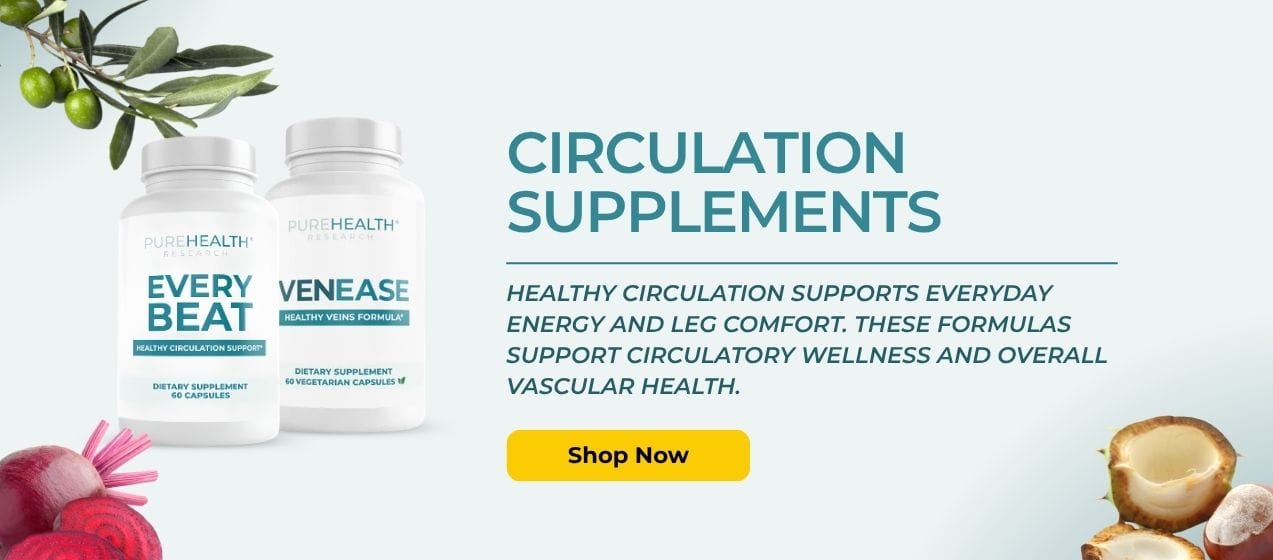
Complete Omega-3 provides 1,300 mg of EPA and 860 mg of DHA in each three-softgel serving to support heart and arterial health. VenEase pairs horse chestnut seed extract with micronized citrus flavonoids, rutin, and butcher’s broom in a formula designed to support venous tone and leg comfort.
Beet Root offers a standardized extract rich in natural nitrates, which the body can convert into nitric oxide. Together, they promote healthy circulation as part of an active daily routine.
Why Stacking Botanicals Creates Synergy
The circulatory system relies on several processes at once, so a multi-pathway approach may offer broader support than a single herb. Pairing a vessel relaxer such as cayenne with a structural supporter such as horse chestnut, for example, may address both how easily blood flows and how well vein walls hold their tone.
Choose combinations with care, though, because several of these herbs may affect blood clotting, and those effects could add up.
Recognizing Quality in Herbal Formulations
A clear label tells you more than a long ingredient list. Before you buy, look for:
- Standardized extracts that state the percentage of the active compound
- Absorption partners, such as black pepper extract (piperine), which raised curcumin absorption by about 2,000% in a small 1998 study in healthy volunteers
- Full dose disclosure for every ingredient, rather than proprietary blends that hide individual amounts
- Third-party testing for purity and potency
Conclusion
Healthy circulation depends on relaxed blood vessels, strong venous walls, and efficient microcirculation. Cayenne may support nitric oxide signaling, horse chestnut may help maintain venous tone, and ginkgo may support blood flow to the brain, while the other six herbs each act on a specific part of blood flow. With consistent daily habits and quality standardized extracts, these herbs for circulation may become a realistic long-term part of your routine.
Horse chestnut and gotu kola are the most studied for leg circulation, since they may support vein tone and wall structure. Daily movement matters too, and these tips on circulation in your feet can help.
Most studies ran for four to twelve weeks before measuring results, so expect gradual changes rather than quick ones. Individual responses vary with the herb, the dose, the form, and your overall routine.
Many people use these herbs daily, and most studies used daily doses. Follow the label’s serving size, choose standardized extracts, and check with a healthcare professional if you are pregnant, have a health condition, or have surgery planned.
Not always. Ginkgo may increase bleeding risk alongside anything prescribed to slow clotting, and garlic and ginger may have similar effects. Share your full supplement list with your healthcare professional or pharmacist before combining them.

Advertisement. This site offers health, wellness, fitness and nutritional information and is designed for educational purposes only. You should not rely on this information as a substitute for, nor does it replace, professional medical advice, diagnosis, or treatment. If you have any concerns or questions about your health, you should always consult with a physician or other health-care professional. Do not disregard, avoid or delay obtaining medical or health related advice from your health-care professional because of something you may have read on this site. The use of any information provided on this site is solely at your own risk.
Related Articles
10 Exercises to Improve Circulation (No Equipment)
Written by Laura Kraujalyte | September 18, 2026

12 Foods That Improve Blood Flow
Written by Laura Kraujalyte | September 14, 2026
Why Are My Feet So Cold? When It’s Normal, When It’s Not
Written by Laura Kraujalyte | September 7, 2026

How to Improve Circulation in Feet: Complete 9-Step Guide
Written by Donatas Leikas | August 30, 2026

Does Ashwagandha Lower Blood Pressure?
Written by Laura Kraujalyte | May 11, 2026
A Complete Guide to the Best Vitamins for Blood Flow
Written by Donatas Leikas | September 16, 2025