What Actually Works for Lymphatic Drainage: An Evidence Review
Dry brushing, compression, massage, which lymphatic drainage methods have real evidence? An evidence review of what's actually been studied.



 On This Page:
Search “lymphatic drainage” and you’ll find dry brushing, rebounders, jade rollers, detox teas, compression sleeves, massage guns, and a great many supplements. Search the same term in a medical database and you’ll find something narrower: a modest set of interventions that have been tested in humans, with effect sizes that are real but rarely dramatic.
This article covers the second list. What has been studied, in whom, how well it worked, and where the evidence genuinely runs out. Every figure links to its original source.
A note on why this is harder to answer than it sounds, before we start.
The measurement problem
Testing whether something helps the lymphatic system is harder than testing whether something lowers blood pressure. There’s no cuff for lymph.
A 2014 review in Microvascular Research, drawing on 154 references, lays out the imaging techniques researchers use to assess lymphatic anatomy and function, and the review exists precisely because assessment is difficult and evolving. Most clinical trials therefore fall back on proxies: limb volume, tissue water content, inflammatory markers, patient-reported symptoms.
This matters when reading any claim in this space. “Supports lymphatic drainage” is easy to say and difficult to demonstrate. When you see an effect size below, note what was actually measured.
Compression And Manual Lymphatic Drainage
The best-quality evidence in this field comes from lymphedema research, where the stakes justified proper trials.
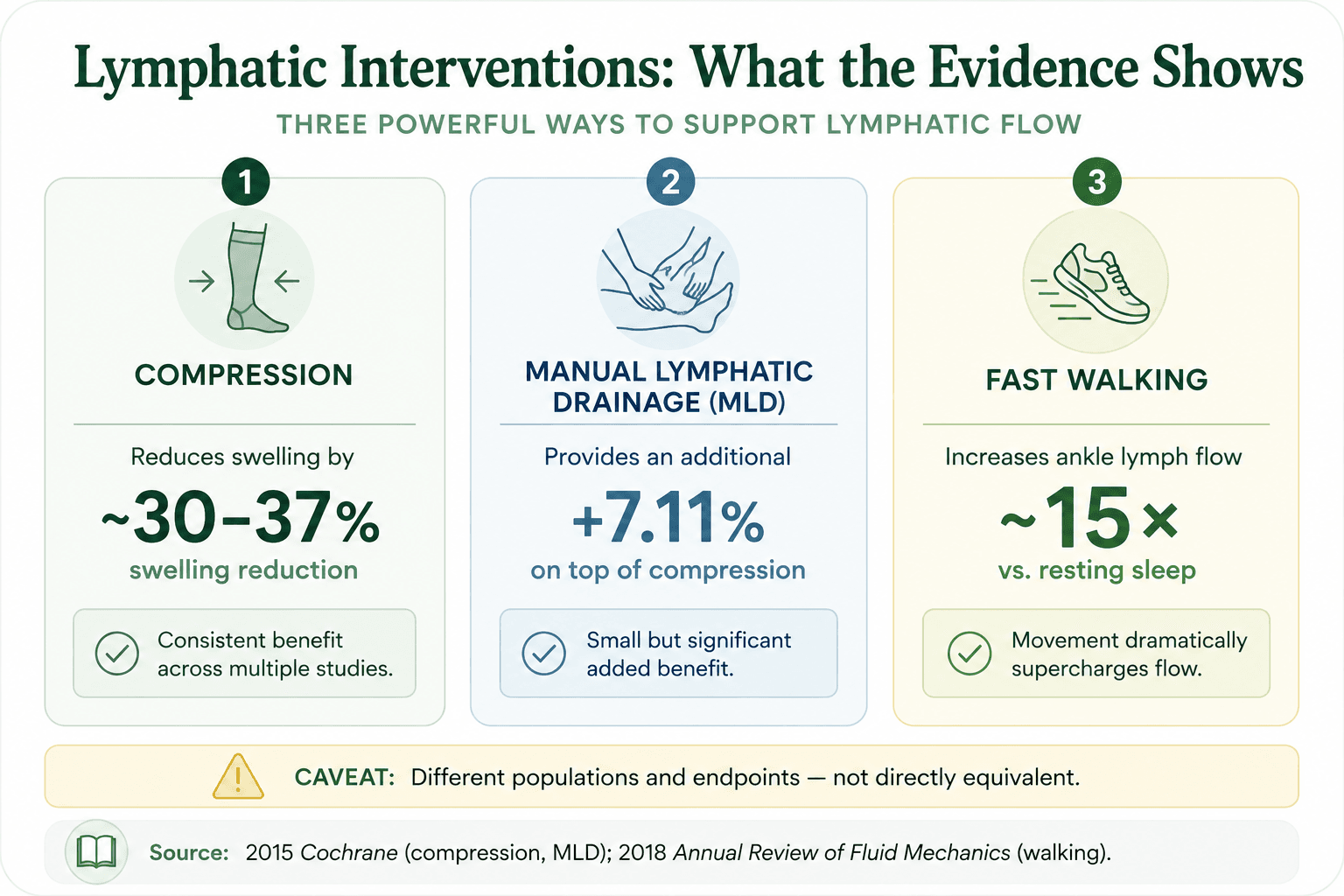
A 2015 Cochrane systematic review pooled 6 trials with 208 participants examining manual lymphatic drainage (MLD) for lymphedema following breast cancer treatment. The findings:
- Compression bandaging alone reduced swelling by roughly 30-37%
- Adding MLD produced an additional 7.11% reduction
- MLD was found to be safe, with benefit most apparent in mild-to-moderate cases
Two things are worth drawing out. First, the headline number belongs to compression, not massage, mechanical pressure did most of the work. Second, a 7.11% additional effect is genuine but modest, and it’s the honest figure. Content that presents manual drainage as transformative is not describing this data.
MLD has also been tested outside lymphedema. A 2015 study in the Journal of Physical Therapy Science applied MLD after submaximal exercise in 18 healthy male participants and found faster reductions in blood lactate, LDH, CK and myoglobin compared with controls, consistent with improved clearance of metabolic byproducts. A small study, and a single session, but one of the few conducted in healthy people rather than patients.
And a 2026 study in Experimental Gerontology followed 201 elderly hip fracture patients (96 receiving MLD plus conventional therapy, 105 conventional therapy alone). The MLD group showed lower IL-6 (9.56 vs 10.03 pg/mL, p=0.036), better six-minute walk distance (458.92 vs 440.65 m, p=0.010) and higher Harris Hip Scores (73.10 vs 68.53, p=0.008). Statistically significant, clinically modest, which is a fair description of this literature generally.
Movement: The Most Supported
Nobody sells movement, which may explain why it’s underrepresented in lymphatic content despite having the cleanest mechanism.
The lymphatic system has no central pump. It relies on vessel contractions, one-way valves, and external forces, chiefly muscle contraction, breathing and body motion. A 2018 review in the Annual Review of Fluid Mechanics reports that fast walking increased ankle lymph flow approximately 15-fold compared with resting sleep.
The mechanism was measured directly in a 2011 study in The Journal of Physiology: tissue motion generates transmural pressure gradients of roughly 4-10 mmHg, sufficient to drive both lymph formation and onward movement.
Compare the numbers honestly. Manual drainage adds ~7% on top of compression in clinical lymphedema. Walking multiplies ankle lymph flow by roughly fifteen in healthy people. Different measures, different populations, but the direction is unmistakable, and movement costs nothing.
We cover this in more depth in our guide to exercises for lymphatic drainage.
Device-Assisted Approaches
Beyond hands and compression garments, several device-based therapies have been trialled.
A 2008 study in the Journal of Rehabilitation Medicine tested Deep Oscillation, low-intensity, extremely low-frequency electrostatic field therapy, added to manual lymphatic drainage in 21 patients with secondary breast lymphoedema (11 treatment, 10 control). Results: pain fell from 4.0 to 2.1, and breast volume decreased by 15.7 mL in the treatment group while increasing by 13.3 mL in controls (p=0.007).
The effect was statistically significant. The study was also very small, from 2008, and in a specific clinical population, all three of which limit how far it generalizes. That’s the honest reading, and it’s how a careful reviewer would characterize it.
This is the pattern across device research in this area: promising signals, small samples, few replications.
Nutrition And The Gut–Lymph Connection
Two distinct findings here, and they’re often conflated.
Diet demonstrably changes lymphatic load. Research on chyle leaks reports thoracic duct flow ranging from roughly 550 mL/day during fasting to nearly 5,600 mL/day after meals, because long-chain dietary fats are transported through the lymphatic system while medium-chain triglycerides largely bypass it (Nutrition in Clinical Practice, 2016). This is well established, it’s used clinically.
Whether nutrition improves lymphatic function is a separate, less settled question. The most interesting trial to date: a 2020 study in the EXCLI Journal randomized 88 women with breast cancer-related lymphedema to synbiotic supplementation plus a low-calorie diet, or placebo plus diet, for 10 weeks. Edema volume fell 37.36% in the synbiotic group versus 20.75% in placebo, with reductions in TNF-α (p=0.039) and leptin (p=0.003).
That’s a genuine randomized trial with a meaningful effect. It also came alongside a calorie-restricted diet, ran for 10 weeks, and was conducted in women with an existing clinical condition. It does not tell us what synbiotics do for lymph flow in a healthy adult, and nobody should present it as though it does.
Body weight itself appears to matter. A 2022 review in the Journal of Preventive Medicine and Hygiene reports that obesity may increase secondary lymphedema risk by up to three times, and a 2024 review in the Gazi Journal of Health Sciences describes nutrition’s supportive role in lymphedema management as working largely through healthy body weight, gut health and reduced lymphatic load, indirect routes rather than direct stimulation of lymph flow.
Botanicals: What The Systematic Reviews found
This is the section that matters most for anyone evaluating a supplement, so here it is plainly.
A 2015 systematic review in PM&R searched major medical databases for botanical therapies used in lymphedema and identified 11 botanical studies among 85 evidence-based lymphedema therapy articles. The botanicals examined included horse chestnut, butcher’s broom, Pycnogenol and Centella asiatica. Several showed potential benefits for circulation, inflammation or edema in general. Evidence supporting their use specifically for lymphedema remained limited.
That distinction, general circulatory and inflammatory effects versus demonstrated lymphatic effects, is the crux of the whole category. Some of these botanicals have reasonable evidence in venous conditions. Extending that to lymphatic flow is an inference, not a finding.
A 2022 review in the Journal of Preventive Medicine and Hygiene reaches a compatible conclusion: nutritional status and antioxidant compounds may influence lymphatic physiology, and the area is being actively explored, but the research base is early.
Some early work exists on individual compounds, hydroxytyrosol has been discussed for its antioxidant and anti-inflammatory properties in the context of lymphatic fluid accumulation (Acta Biomedica, 2020), but much of it is preclinical or in animal models, and shouldn’t be read as human evidence.
The fair summary: the drivers of lymph flow with solid human evidence are mechanical, movement, compression, muscle contraction and breathing. Nutritional and botanical approaches are a supporting area with early, mixed and mostly indirect evidence. Anyone telling you otherwise is ahead of the data.
The Evidence Scorecard
| Intervention | Best available evidence | Effect reported | Population | Confidence |
| Compression therapy | Cochrane review, 6 trials, 208 participants | ~30–37% swelling reduction | Breast cancer-related lymphedema | Strong |
| Movement / walking | Physiological measurement studies | ~15× increase in ankle lymph flow vs. rest | Healthy adults | Strong (mechanism) |
| Manual lymphatic drainage | Cochrane review; 201-patient post-surgical trial | +7.11% on top of compression; modest post-surgical gains | Clinical populations | Moderate |
| Device-assisted (Deep Oscillation) | Single 21-patient RCT, 2008 | Pain 4.0 → 2.1; breast volume −15.7 mL vs +13.3 mL | Secondary breast lymphoedema | Limited |
| Synbiotics / gut support | Single 88-participant RCT, 10 weeks | 37.36% vs 20.75% edema reduction | Clinical, alongside calorie restriction | Limited |
| Botanicals | Systematic review, 11 studies of 85 | Signals for circulation/inflammation; lymphatic-specific evidence limited | Mixed | Limited |
| Dietary fat composition | Clinical nutrition research | Thoracic duct flow 550 → 5,600 mL/day fasting vs fed | Clinical | Established mechanism |
What This Means In Practice
If you’re supporting a healthy lymphatic system day to day, the research points somewhere unexciting and reliable: move regularly, breathe deeply, stay hydrated, maintain a healthy weight, and don’t sit still for hours at a stretch. These are the interventions with mechanism and measurement behind them.
If you’re managing diagnosed lymphedema, the evidence supports compression as the foundation, with manual lymphatic drainage as a worthwhile addition, under the guidance of a trained therapist, not a YouTube tutorial.
And if you’re considering nutritional support, the reasonable framing is complementary, not primary. PureHealth Research’s Lymphatic Drainage Supplements are formulated with botanicals traditionally associated with fluid balance and lymphatic wellness, intended to sit alongside movement and hydration rather than substitute for them. The ingredient breakdown is here.
Conclusion
The evidence base for lymphatic interventions is smaller and more modest than the marketing around it, but it isn’t empty. Compression works. Movement works, with the largest measured effect of anything in the literature. Manual drainage adds a real if modest increment. Nutrition and botanicals are an early, mixed and mostly indirect area where honest researchers say “promising” and mean it literally.
Knowing which category a given recommendation falls into is most of what it takes to navigate this field sensibly.
A 2015 Cochrane review of 6 trials and 208 participants found manual lymphatic drainage safe and associated with an additional 7.11% swelling reduction when added to compression bandaging in breast cancer-related lymphedema. The effect is real but modest, and compression accounted for the larger share of benefit.
Compression therapy, which reduced swelling by roughly 30–37% in pooled Cochrane data. For healthy adults, movement has the clearest mechanism, fast walking has been measured increasing ankle lymph flow around 15-fold compared with resting sleep.
Evidence specific to lymphatic function is limited. A 2015 systematic review in PM&R identified only 11 botanical studies among 85 evidence-based lymphedema therapy articles, and found that while some botanicals showed potential for circulation and inflammation generally, support for lymphatic use specifically remained limited.
One randomized trial of 88 women with breast cancer-related lymphedema found synbiotic supplementation alongside a low-calorie diet reduced edema volume by 37.36% versus 20.75% with placebo, with reductions in TNF-α and leptin. It’s a single trial in a clinical population combined with calorie restriction, so it shouldn’t be generalized to healthy adults.
A 2008 trial of 21 patients found Deep Oscillation therapy added to manual drainage significantly reduced pain and breast swelling versus manual drainage alone. The sample was very small and the finding has limited replication, so confidence remains low.
Research suggests it does. A 2022 review reports obesity may increase secondary lymphedema risk by up to three times, and nutritional approaches to lymphedema management appear to work substantially through healthy body weight rather than direct effects on lymph flow.
With difficulty, which is part of why the evidence base is thin. A 2014 Microvascular Research review covering 154 references describes the imaging techniques used to assess lymphatic anatomy and function. Most clinical trials rely on proxies such as limb volume, inflammatory markers and patient-reported symptoms.
If swelling appears suddenly, affects one limb only, worsens, or comes with pain, redness or warmth. Persistent swelling has several possible causes that require proper diagnosis.

Advertisement. This site offers health, wellness, fitness and nutritional information and is designed for educational purposes only. You should not rely on this information as a substitute for, nor does it replace, professional medical advice, diagnosis, or treatment. If you have any concerns or questions about your health, you should always consult with a physician or other health-care professional. Do not disregard, avoid or delay obtaining medical or health related advice from your health-care professional because of something you may have read on this site. The use of any information provided on this site is solely at your own risk.
Related Articles
Can Lymphatic Drainage Make You Sick?
Written by Laura Kraujalyte | September 4, 2026

How to Treat Swollen Face: Puffiness vs Real Swelling
Written by Laura Kraujalyte | August 31, 2026

8 Ways to Reduce Swelling in Hands at Home
Written by Laura Kraujalyte | August 28, 2026
Does Deep Breathing Help the Lymphatic System?
Written by Laura Kraujalyte | August 24, 2026

Dry Brushing for Lymphatic Drainage: Does It Work?
Written by Laura Kraujalyte | August 21, 2026

How to Detox Your Lymphatic System Naturally: The Complete 8-Step Guide
Written by Karolina Rutkute | August 6, 2026