The Lymphatic System by the Numbers: What the Research Actually Shows
Your lymphatic system moves 8 liters of fluid daily with no pump. Peer-reviewed data on how it works and why it's understudied.



 On This Page:
Most people meet their lymphatic system twice: once in a biology class they’ve forgotten, and once when something swells. In between, it moves several liters of fluid through your body every single day without a pump, a heartbeat, or any conscious effort on your part.
It’s also the part of human circulation that science neglected longest. Researchers writing in the Journal of Anatomydescribe the 17th century as the “golden age” of lymphatic discovery, and then note that the field went comparatively quiet for centuries afterward. One 2017 review of lymphatic anatomy points out that detailed gross-anatomical study of the system was largely set aside for nearly 100 years before modern mapping techniques revived it.
That gap is closing fast. Below is what peer-reviewed research says about how the lymphatic system works, how much it moves, what makes it flow, and where the evidence is genuinely strong, and where it isn’t. Every figure links to its original source.
The Lymphatic System Moves More Fluid
Your blood capillaries leak. Constantly, and by design. Plasma seeps out into the spaces between cells, delivering oxygen and nutrients, and most, but not all, of it returns through the veins. What’s left behind is the lymphatic system’s job.
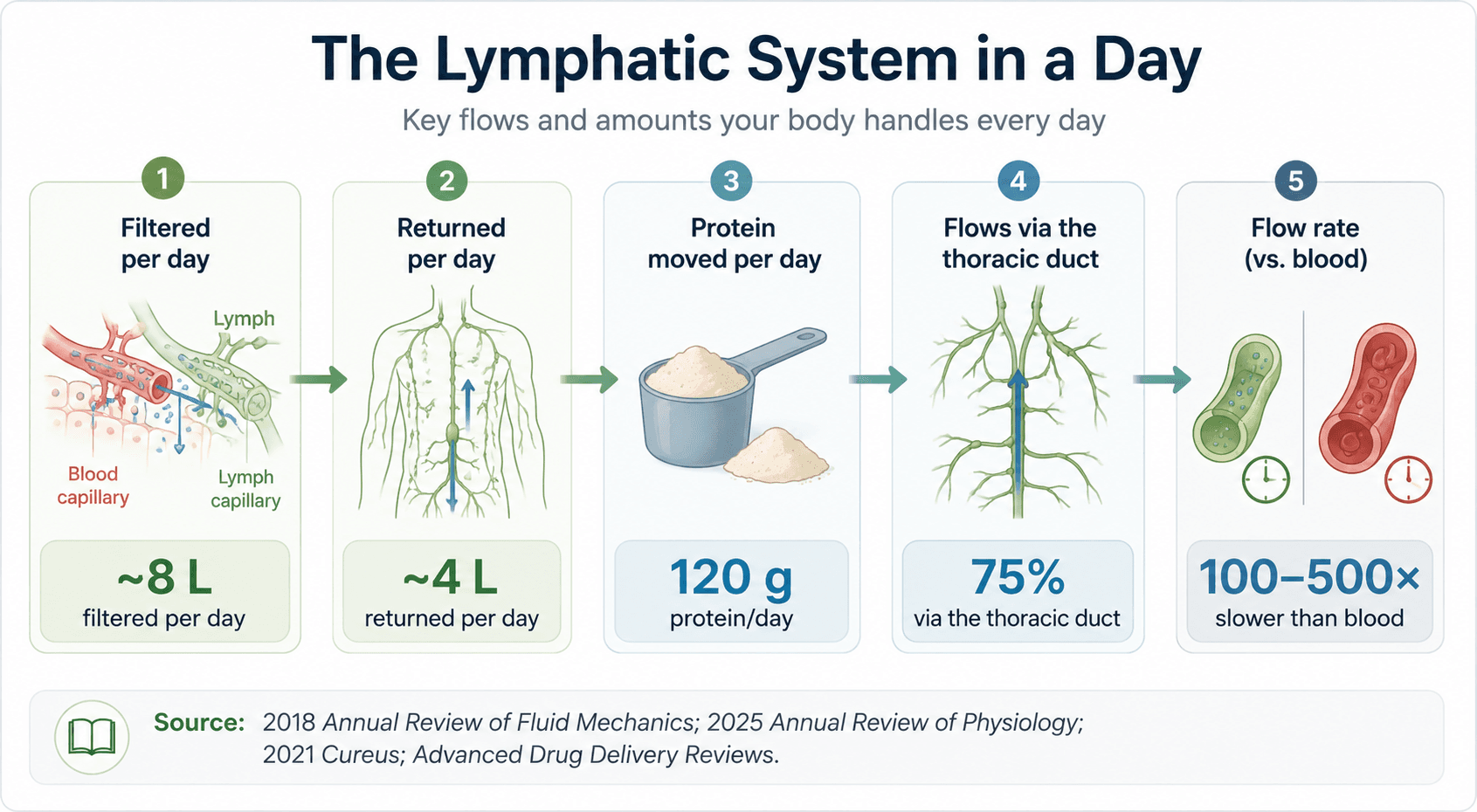
The volumes involved are larger than most people expect. A 2018 review in the Annual Review of Fluid Mechanics reports that around 8 liters of fluid per day becomes afferent lymph, with roughly 4 liters per day continuing as postnodal flow back toward the bloodstream. A 2025 review in the Annual Review of Physiology puts human lymph transport at more than 8 liters of fluid and 120 grams of protein per day.
That protein figure matters more than it sounds. Proteins that escape into tissue are too large to slip back into blood capillaries. Without lymphatic collection, they accumulate, draw water with them by osmosis, and tissue swells. The lymphatic system is the only route home for them.
Where does it all go? A 2021 review in Cureus notes that approximately 75% of lymphatic fluid drains through the thoracic duct into venous circulation near the base of the neck, a single vessel roughly the width of a drinking straw handling three-quarters of the body’s lymphatic return.
And it does all this slowly. Research published in Advanced Drug Delivery Reviews describes lymph flow as roughly 100 to 500 times lower than blood flow. This isn’t a design flaw. It’s a filtration system, not a delivery system, and filtration takes time.
Movement Matters the Most
The circulatory system has a heart. The lymphatic system has nothing equivalent. Lymph moves through a combination of spontaneous contractions in the vessel walls, one-way valves that prevent backflow, and, critically, external forces generated by your body moving.
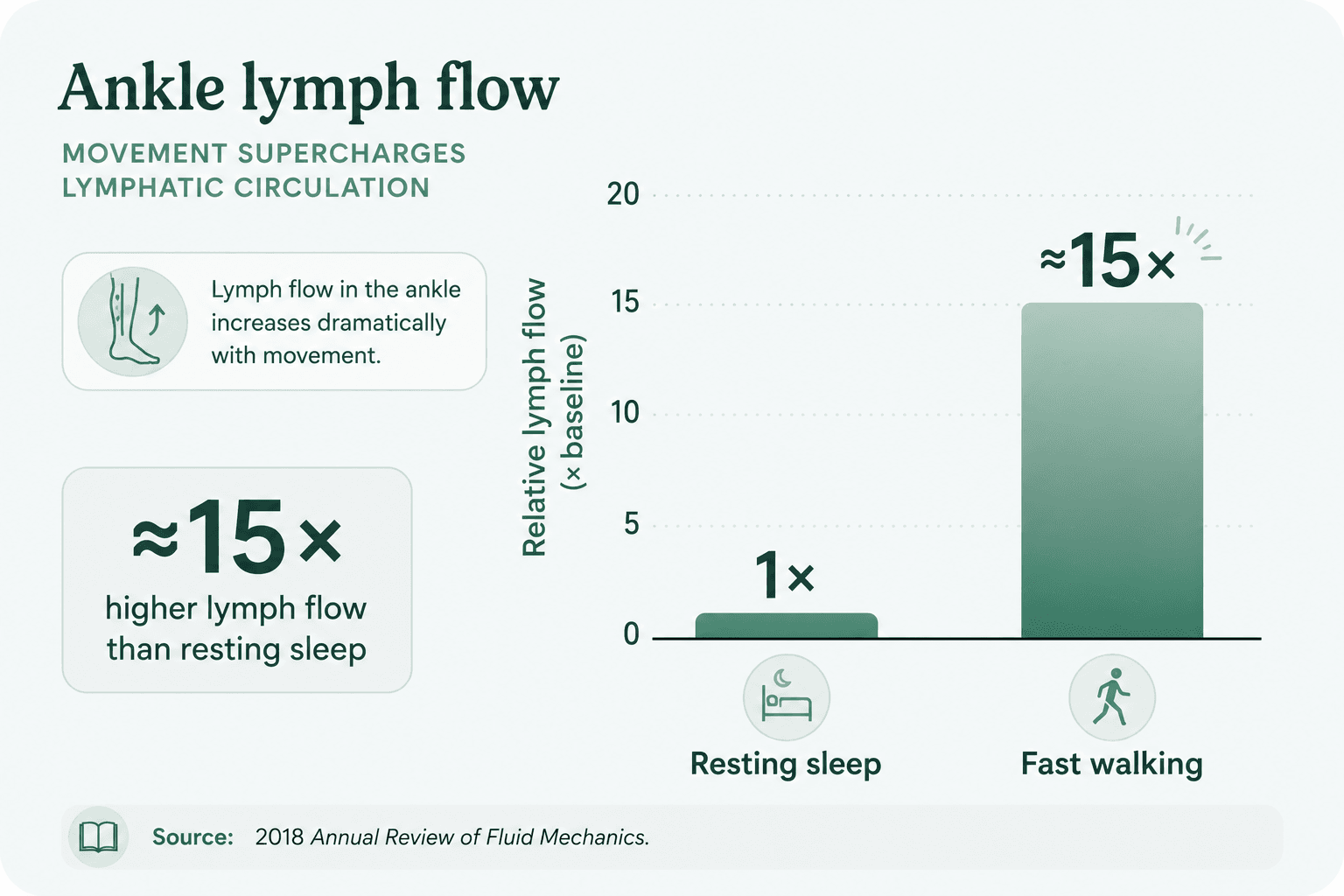
The most striking demonstration of this comes from the same 2018 Annual Review of Fluid Mechanics paper: fast walking increased ankle lymph flow approximately 15-fold compared with resting sleep.
The mechanism behind that number was measured directly in a 2011 study in The Journal of Physiology, which found that tissue motion generates transmural pressure gradients of roughly 4-10 mmHg across lymphatic vessel walls, enough to drive both lymph formation and its movement onward. The same research measured vessel compliance varying between 1.5 and 6.7 nl·mmHg⁻¹ depending on vessel structure, meaning different parts of the network respond differently to the same mechanical push.
The entry points are remarkably fine-tuned. A 2015 review in Seminars in Cell & Developmental Biology describes initial lymphatic valves creating openings of roughly 2–3 micrometers, wide enough to admit fluid, particles and whole immune cells, then closing behind them.
Even the slow drift of fluid through tissue does work. A 2017 review in the Annual Review of Immunology reports interstitial flow of approximately 0.2 micrometers per second, glacial, but fast enough to create the chemical gradients that guide immune cells toward lymphatic vessels.
The practical takeaway is simple and well-supported: sitting still is the one thing the lymphatic system has no workaround for. For specific movement patterns, see our guide to the best exercises for lymphatic drainage.
It Does More Than Drain Fluid
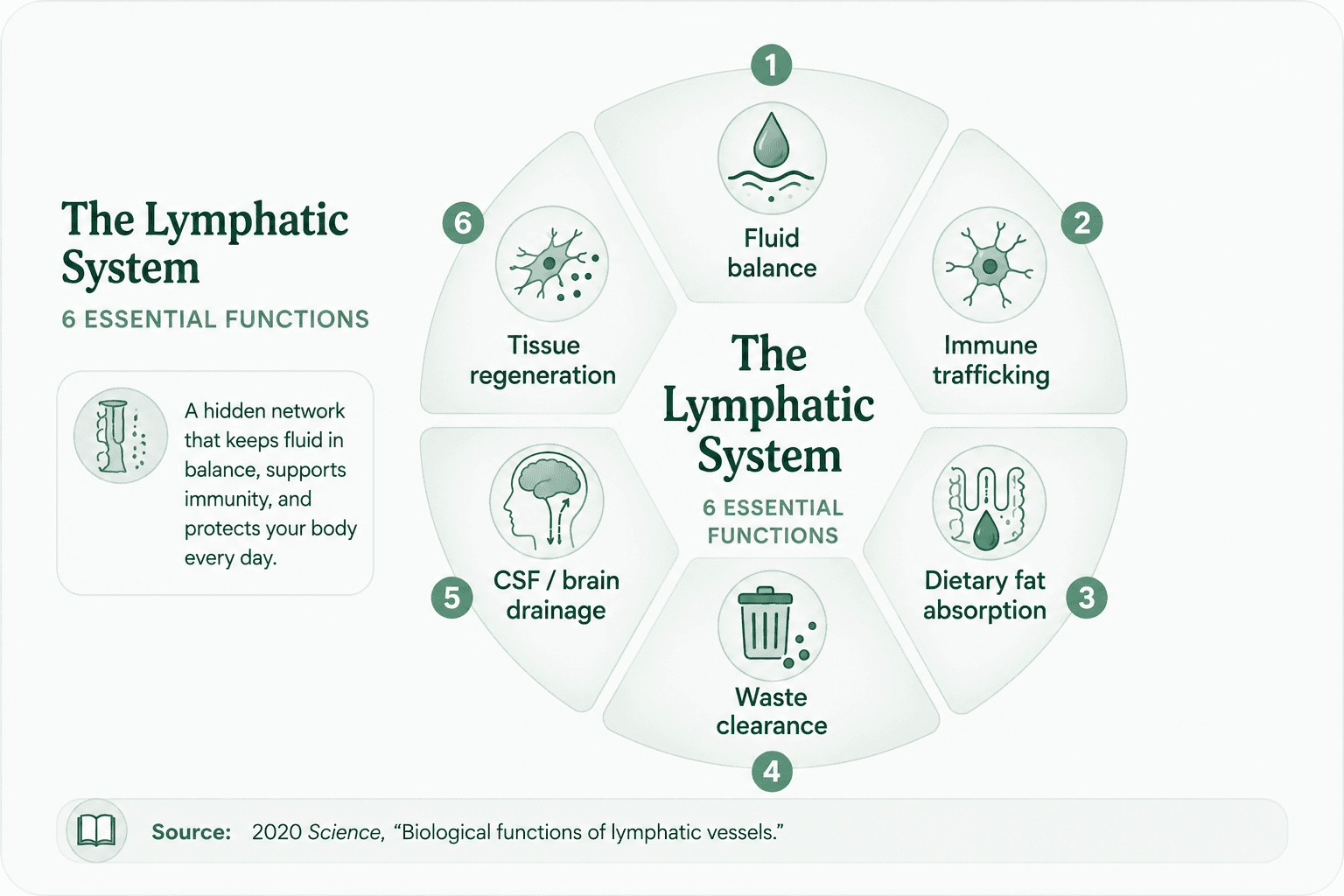
For most of the 20th century, the lymphatic system was taught as plumbing. A 2020 review in Science, cited over 370 times, argues that framing is now badly out of date. Lymphatic vessels, the authors describe, regulate immune surveillance and immune cell function, absorb dietary fat, participate in cerebrospinal fluid drainage, and show emerging links to metabolism, neuroinflammation and cancer biology.
Four functions are now reasonably well established:
Immune coordination. A 2016 review in Immunological Reviews describes lymphatic vessels as active coordinators of immune cell traffic rather than passive transport routes. The cells lining them can influence immune responses directly through antigen presentation and local signaling.
Dietary fat transport. Fats absorbed from the intestine largely bypass the bloodstream initially and travel through lymphatic vessels first, which is why lymph after a meal looks milky.
Brain fluid clearance. The Science review notes lymphatic involvement in cerebrospinal fluid drainage, an area of very active current research.
Tissue repair. A 2023 study in Cell identified lymphatic vessels inside both mouse and human bone and found they participate in regeneration after injury. Lymphatic vessel density increased following radiation injury, peaking around day 15, and blocking lymphatic growth impaired both bone and blood-forming tissue recovery. (Note: the regenerative mechanism here was studied primarily in animal models.)
A 2022 review in Physiological Reviews summarizes the direction of travel plainly: lymphatic vessels are present in almost every tissue in the body, and are essential to fluid balance and immune function throughout.
What You Eat Changes Lymphatic Flow
This is the finding most likely to surprise people, and it comes from an unexpected corner of the literature: research on chyle leaks, a complication where lymphatic fluid escapes after chest or abdominal surgery.
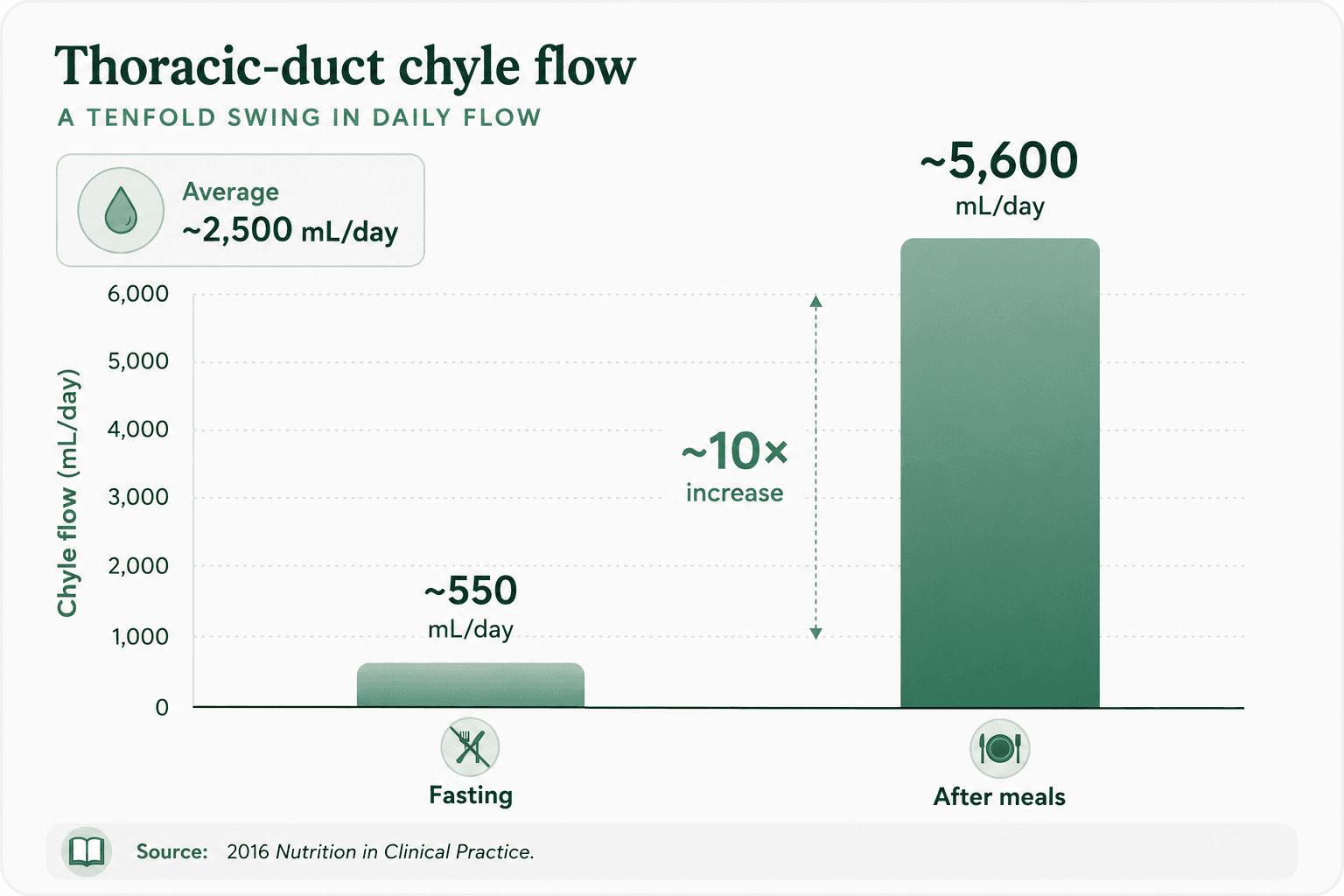
Because clinicians needed to reduce lymphatic flow in these patients, they measured it precisely. A 2016 paper in Nutrition in Clinical Practice reports that roughly 2,500 mL of chyle passes through the thoracic duct daily, but that flow ranges from about 550 mL/day during fasting to nearly 5,600 mL/day after meals. A tenfold swing, driven by food.
The reason is fat chemistry. Long-chain fats are packaged into chylomicrons and routed through the lymphatic system. Medium-chain triglycerides (MCTs) are absorbed differently and bypass much of that route, which is why MCT-based nutrition is used clinically to reduce lymphatic load.
That’s a real, measurable dietary effect on lymphatic transport, and it’s worth being precise about what it does and doesn’t mean. It shows that lymphatic flow responds to food. It does not show that any particular food or supplement improves lymphatic function in healthy people.
On that second question, the evidence is thinner than the marketing in this category suggests. A 2015 systematic review in PM&R searched the literature for botanicals used in lymphedema, horse chestnut, butcher’s broom, Pycnogenol and Centella asiatica among them, and identified 11 botanical studies out of 85 evidence-based lymphedema therapy articles. Some showed signals for circulation, inflammation or edema generally. Evidence specific to lymphatic function remained limited.
A 2022 review in the Journal of Preventive Medicine and Hygiene reaches a similar place: nutrition and nutritional status may influence lymphatic physiology, and anti-inflammatory and antioxidant compounds are being explored, but the field is early.
The honest summary: movement, breathing and muscle contraction are the established drivers of lymph flow.Nutrition plays a supporting role that researchers are still mapping. If a product promises to “flush” your lymphatic system, the research doesn’t currently support that framing.
When lymphatic flow fails: the scale of the problem
Understanding what the lymphatic system does day to day is easier when you see what happens when it doesn’t.
Lymphedema, persistent swelling caused by impaired lymphatic drainage, affects an estimated 3 million people in the United States and between 140 and 250 million people globally, according to the 2022 Journal of Preventive Medicine and Hygiene review. The same review notes that obesity may increase the risk of secondary lymphedema by up to three times.
Cancer treatment is a major driver. A 2004 review in Developmental Dynamics reports that 25–56% of breast cancer patients develop mild or severe lymphedema following treatment.
What helps is reasonably well studied. A 2015 Cochrane systematic review pooling 6 trials and 208 participants found compression bandaging reduced swelling by roughly 30–37%, and that adding manual lymphatic drainage produced an additional 7.11% reduction, with the technique found to be safe. Modest, but real, and notably, it’s the mechanical intervention that carries the evidence.
There are hints the same principle extends beyond clinical swelling. A 2015 study in the Journal of Physical Therapy Science found that manual lymphatic drainage after submaximal exercise was associated with faster clearance of blood lactate and muscle damage markers in 18 healthy male participants, a small study, but consistent with the idea that supporting lymphatic transport helps clear metabolic byproducts.
Persistent, sudden or worsening swelling is a medical issue, not a wellness one. If you’re experiencing it, speak to a healthcare provider rather than self-treating.
Supporting Healthy Lymphatic Flow Day To Day
Pulling the research together, the pattern is consistent. The lymphatic system moves a large volume of fluid slowly, depends entirely on external forces to do it, and responds to how much you move and what you eat.
The habits that follow from the evidence are unglamorous: move regularly rather than intensely on occasion, breathe deeply, stay hydrated, and avoid long stretches of complete stillness. For a structured routine, see our guides to lymphatic drainage self-massage and a full lymphatic system reset.
Some people also choose to complement those habits with nutritional support. PureHealth Research’s Lymphatic Drainage Supplements use botanicals traditionally associated with lymphatic wellness and fluid balance, formulated to sit alongside movement and hydration rather than replace them. You can read the ingredient-by-ingredient breakdown here.

Conclusion
The lymphatic system handles around 8 liters of fluid and 120 grams of protein a day, has no pump, and speeds up roughly fifteenfold when you walk briskly rather than lie still. It coordinates immune traffic, carries dietary fat, participates in brain fluid clearance and contributes to tissue repair. And it responds to your daily choices in ways researchers can now measure.
It’s the least famous circulatory system in the body, and after four centuries of relative neglect, the data is finally catching up.
Research in the Annual Review of Fluid Mechanics reports that roughly 8 liters per day becomes afferent lymph, with about 4 liters continuing as postnodal flow. A 2025 Annual Review of Physiology paper puts total human lymph transport at more than 8 liters of fluid and 120 grams of protein daily.
No. Unlike blood circulation, it has no central pump. Lymph moves through spontaneous contractions in vessel walls, one-way valves, and external forces including muscle contraction, breathing and body movement.
One study measured ankle lymph flow increasing approximately 15-fold during fast walking compared with resting sleep, one of the largest single effects documented for any everyday behavior on lymphatic transport.
A 2020 Science review describes roles in immune surveillance and immune cell function, dietary fat absorption, and cerebrospinal fluid drainage, with emerging research links to metabolism and neuroinflammation. A 2023 Cell study also identified lymphatic vessels in bone that participate in regeneration after injury.
Yes, measurably. Thoracic duct flow ranges from roughly 550 mL/day during fasting to nearly 5,600 mL/day after meals, largely because long-chain dietary fats are transported through the lymphatic system. Medium-chain triglycerides bypass much of that route.
Lymph flow is primarily driven by movement, breathing and muscle contraction, not by oral supplements. A 2015 systematic review in PM&R found evidence for botanicals in this space to be limited, identifying only 11 botanical studies among 85 lymphedema therapy articles. Some ingredients show signals for circulation and inflammatory pathways, but the research base for improving lymph flow specifically in healthy adults is still developing.
An estimated 3 million people in the United States and 140-250 million people worldwide, according to a 2022 review in the Journal of Preventive Medicine and Hygiene.
If swelling appears suddenly, worsens, affects only one limb, is accompanied by pain, redness or warmth, or persists despite movement and elevation, consult a healthcare provider. Persistent swelling can have several causes that require proper diagnosis.

Advertisement. This site offers health, wellness, fitness and nutritional information and is designed for educational purposes only. You should not rely on this information as a substitute for, nor does it replace, professional medical advice, diagnosis, or treatment. If you have any concerns or questions about your health, you should always consult with a physician or other health-care professional. Do not disregard, avoid or delay obtaining medical or health related advice from your health-care professional because of something you may have read on this site. The use of any information provided on this site is solely at your own risk.
Related Articles
Can Lymphatic Drainage Make You Sick?
Written by Laura Kraujalyte | September 4, 2026

How to Treat Swollen Face: Puffiness vs Real Swelling
Written by Laura Kraujalyte | August 31, 2026

8 Ways to Reduce Swelling in Hands at Home
Written by Laura Kraujalyte | August 28, 2026

Does Deep Breathing Help the Lymphatic System?
Written by Laura Kraujalyte | August 24, 2026

Dry Brushing for Lymphatic Drainage: Does It Work?
Written by Laura Kraujalyte | August 21, 2026

How to Detox Your Lymphatic System Naturally: The Complete 8-Step Guide
Written by Karolina Rutkute | August 6, 2026