Peptides by the Numbers: What the Research Actually Shows
"Peptides" spans everything from collagen powder to prescription drugs. Peer-reviewed data on what peptides are and what evidence actually supports.



 On This Page:
“Peptides” might be the most overloaded word in wellness right now. It’s attached to anti-aging creams, collagen powders, muscle forums, longevity podcasts and a fair amount of frankly sketchy internet chemistry. Underneath the hype is something real and quite specific, and worth understanding clearly, because the category spans everything from a scoop of collagen in your coffee to prescription-only medicines.
Here’s what the peer-reviewed literature actually says: what peptides are, which ones have real evidence behind them for everyday wellness, what that evidence shows, and, importantly, where the line sits between a food-derived supplement and a drug. Every figure links to its original source.
What A Peptide Actually Is
Strip away the marketing and a peptide is one of the simplest ideas in biology.
Amino acids are the building blocks of protein. Link a few together in a short chain and you have a peptide; link many hundreds and you have a full protein. That’s the entire distinction, length. Peptides are, in the words of the field’s reference literature, fundamental building blocks that appear throughout the body, doing everything from signaling to structure.
And they are everywhere in human physiology. Foundational reviews document peptides acting as hormones (insulin is a peptide), as neurotransmitters and neuromodulators in the brain, as immune-system components, and as regulators of blood pressure and fluid balance, the natriuretic peptides reviewed in the New England Journal of Medicine being a classic example. The 1983 Science review “Brain Peptides: What, Where, and Why?” was one of several landmark papers establishing just how widespread their roles are.
So when a product says “peptides,” the honest first question is always: which peptides, and doing what?
Peptides Are Serious Medicine
Before getting to supplements, it’s worth understanding why “peptide” sounds impressive: because in medicine, peptides are a large and growing drug class with real clout.
A 2018 review in Bioorganic & Medicinal Chemistry traces therapeutic peptides back to insulin in the 1920s and notes that by then, over 60 peptide drugs were approved in the US, Europe and Japan, with more than 150 in active clinical development. A more recent 2022 review in Signal Transduction and Targeted Therapy updates the picture: more than 80 peptide drugs approved worldwide, peptide-drug sales exceeding $70 billion in 2019, and over 170 peptides in active development.
Peptide drugs are valued, that review explains, for high specificity and potency and generally lower immunogenicity than larger biologic drugs, though they’ve historically been limited by stability and delivery challenges, which is why many are injected rather than swallowed.
This is the crucial context most wellness content skips: the impressive peptide statistics belong to prescription medicines, developed and regulated as drugs. That’s a different universe from a collagen supplement, and conflating the two is exactly how the category gets confusing. Which brings us to the peptides you can actually buy as food.
The Peptides That Matter For Everyday Wellness
Here’s where supplements legitimately enter the picture.
Certain peptides derived from food proteins have measurable biological activity, they’re called bioactive peptides. A 2017 review in Food Quality and Safety describes food-derived bioactive peptides with antioxidant, antihypertensive, antimicrobial and immunomodulatory activity, produced when proteins are broken down (through digestion, fermentation or enzymatic hydrolysis). Reviews of milk-derived and marine-derived peptides describe similar families.
The most studied bioactive peptide in the consumer space, by a wide margin, is collagen. Collagen is the structural protein in skin, joints, tendons and connective tissue, and collagen peptides (also called hydrolyzed collagen) are collagen broken into short, absorbable chains. This is the category PHR’s peptide line sits in, built around collagen-derived tripeptides.
And unlike much of the wellness-peptide world, collagen peptides have a substantial body of human clinical evidence. That’s the next section, and it’s worth being precise about what it shows.
What The Collagen Peptide Evidence Shows
This is the part to get right, because it’s both genuinely positive and frequently overstated.
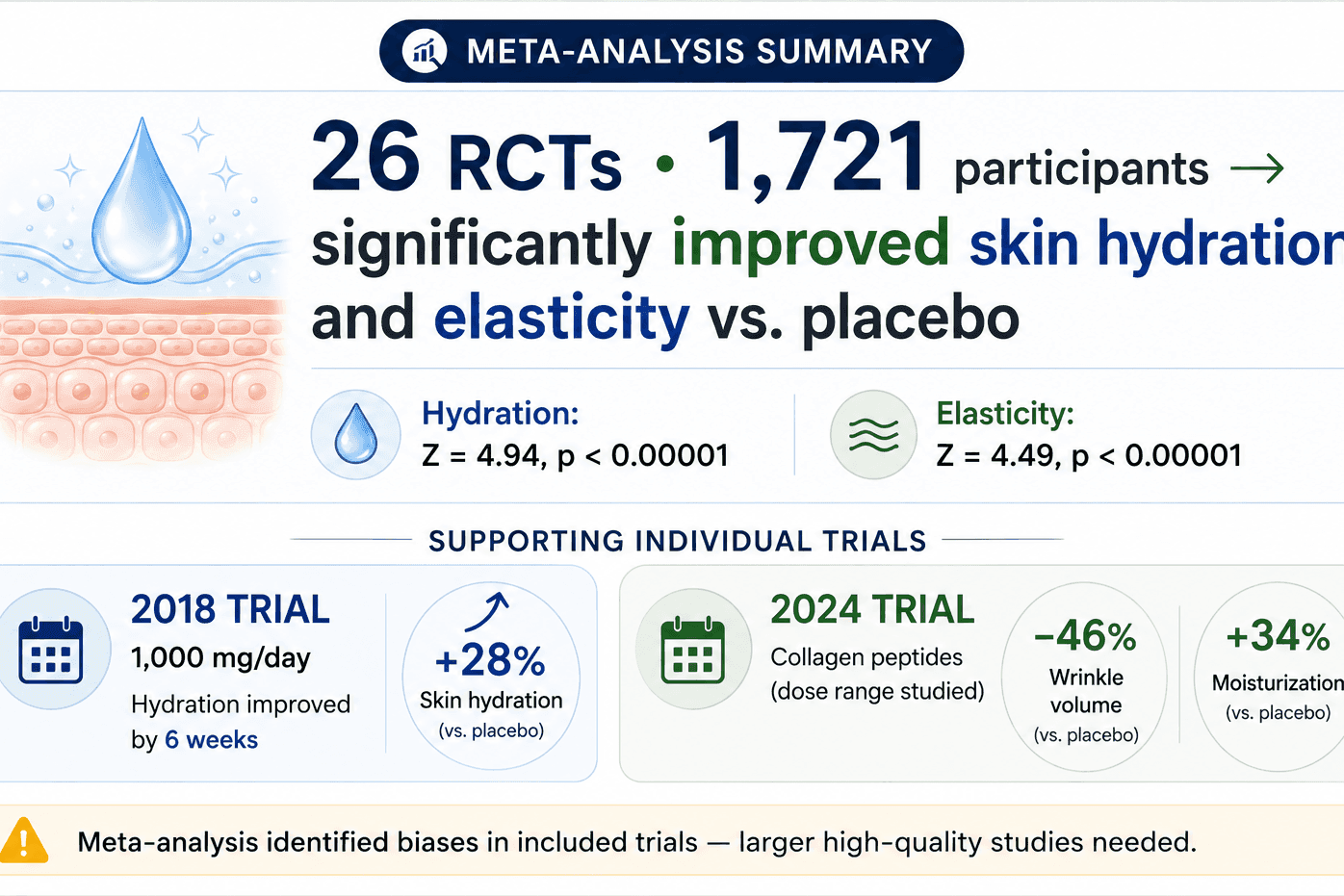
The strongest single piece of evidence is a 2023 systematic review and meta-analysis in Nutrients pooling 26 randomized controlled trials with 1,721 participants. It found that hydrolyzed collagen supplementation significantly improved skin hydration (Z = 4.94, p < 0.00001) and elasticity (Z = 4.49, p < 0.00001) compared with placebo. Those are strong statistical signals across a large pooled population.
Individual trials fill in the picture:
- A 2018 RCT in Nutrients gave 64 participants 1,000 mg/day of low-molecular-weight collagen peptide for 12 weeks and found significantly improved skin hydration by 6 weeks and improved wrinkling and elasticity by 12 weeks, versus placebo.
- A 2023 double-blind RCT in Food & Function gave 100 women aged 30–60 a collagen peptide for 12 weeks and reported improvements in hydration, elasticity, wrinkling and desquamation, with no side effects reported during the study.
- A 2024 RCT in Cosmetics found low-molecular-weight collagen peptides reduced wrinkle volume by 46% and improved skin moisturization by 34% versus placebo over six weeks (p < 0.001).
Now the honest caveats, because they matter for credibility. The 2023 Nutrients meta-analysis itself identified several biases in the included trials and concluded that larger, high-quality studies are still needed to confirm the findings. Many trials are industry-funded. And a 2026 review in Springer’s Food, Nutrition and Health notes an important asymmetry: while oral collagen peptides have substantial human evidence for skin, topical collagen evidence is weaker, because collagen’s molecular size limits skin penetration, one reason the oral route is the one with the data.
The fair summary: collagen peptides are one of the better-evidenced supplement ingredients for skin hydration and elasticity, with real randomized-trial support, and the sensible framing is “supported by encouraging clinical evidence that’s still maturing,” not “clinically proven miracle.”
Does Swallowing Collagen Actually Reach Your Skin?
A reasonable skeptic’s question: if collagen is just protein, doesn’t your gut break it into amino acids like any steak, making “collagen peptide” marketing meaningless?
The research offers a more interesting answer. Studies on low-molecular-weight collagen peptides focus specifically on small di- and tripeptides, such as Gly-Pro-Hyp (glycine–proline–hydroxyproline), and the 2018 Nutrients trial and 2023 Food & Function trial report that some of these short peptides survive digestion intact and appear in the bloodstream, where they’re thought to act as signals that support the body’s own collagen-related processes rather than simply serving as raw material.
That’s the mechanistic rationale behind low-molecular-weight and tripeptide formulations specifically: smaller, hydroxyproline-containing peptides appear more resistant to complete breakdown and more bioavailable. It’s an active area of research rather than a fully settled mechanism, but it’s a real scientific reason the form of collagen peptide is emphasized, not just marketing.
The Category’s Honest Dividing Line
Because “peptides” now covers so much ground, one distinction is worth stating plainly for anyone navigating this space.
On one side: oral bioactive peptides like collagen, food-derived, taken by mouth, sold as dietary supplements, with a real and growing evidence base and a well-characterized safety profile in the trials above.
On the other: unapproved injectable “research” peptides sold online, often labeled “for research use only, not for human consumption.” These are not approved for human use, are not dietary supplements, and their safety and efficacy in people are not established. The reassuring statistics about peptide medicines (the $70 billion, the 80+ approved drugs) refer to properly developed and regulated pharmaceuticals, not to anything bought from an unregulated website.
If you take one thing from this article: the peptide category is only as trustworthy as the specific product and its evidence. Collagen peptides from a reputable, tested supplement are a very different proposition from an injectable ordered off the internet, and they shouldn’t be lumped together just because they share a word.
Supporting Skin, Joints And Connective Tissue Day To Day
The research-backed foundations for the tissues collagen supports are, as usual, unglamorous: adequate protein and vitamin C (a cofactor for collagen synthesis), sun protection, not smoking, sleep, and staying active to support joints and connective tissue.
Collagen peptides are one of the more reasonably evidenced supplement additions to that foundation. PureHealth Research’s Natural Peptides Supplements is built around Morikol® collagen tripeptides, a low-molecular-weight, bioavailable form of exactly the peptide class the clinical trials above studied, formulated to support skin elasticity, joint comfort and connective-tissue integrity as part of a healthy-aging routine. As with any supplement, it works best alongside the dietary and lifestyle basics, not instead of them, and anyone with a medical condition or on medication should check with their healthcare provider first.
Conclusion
Peptides are short chains of amino acids that run much of human physiology and make up a major, multi-billion-dollar class of medicines. For everyday wellness, the peptides that matter most are bioactive food peptides, above all collagen, which has real randomized-trial evidence for improving skin hydration and elasticity, with the honest caveat that the trials have limitations and larger studies would strengthen the case. The single most useful habit in this category isn’t a product; it’s asking which peptide, in what form, with what evidence, because the word covers everything from a well-studied supplement to things that don’t belong in your body at all.
A peptide is a short chain of amino acids, the same building blocks that make up proteins. The difference between a peptide and a protein is essentially length: peptides are short, proteins are long. Peptides act as hormones, signals, and structural components throughout the body.
Yes, though it depends heavily on which peptide. Peptides are a major drug class, more than 80 peptide medicines are approved worldwide, with sales exceeding $70 billion in 2019. Among supplements, collagen peptides have the strongest evidence, with a 2023 meta-analysis of 26 randomized trials finding improved skin hydration and elasticity.
A 2023 meta-analysis of 26 RCTs (1,721 participants) found collagen peptide supplementation significantly improved skin hydration and elasticity versus placebo. The evidence is encouraging, but the same analysis noted biases in the included trials and called for larger high-quality studies, so it’s best described as well-supported rather than definitively proven.
Research on low-molecular-weight collagen peptides suggests certain small peptides, such as Gly-Pro-Hyp, can survive digestion and appear in the bloodstream, where they may act as signals supporting the body’s collagen-related processes. This is why the specific form (low molecular weight, tripeptides) is emphasized. The mechanism is still an active research area.
No, and this matters. Oral bioactive peptides like collagen are food-derived dietary supplements with real evidence and well-characterized safety. Unapproved injectable “research” peptides sold online are not approved for human use, are not supplements, and their safety and efficacy in people are not established. The two shouldn’t be confused.
Length. Both are chains of amino acids; peptides are short (a few to a few dozen amino acids), while proteins are long chains, often hundreds of amino acids folded into complex structures.
In the clinical trials discussed here, collagen peptide supplementation was generally well tolerated, with one 12-week study of 100 women reporting no side effects. As with any supplement, individual responses vary, and anyone with a medical condition, allergy, or who is pregnant or on medication should consult a healthcare provider first.

Advertisement. This site offers health, wellness, fitness and nutritional information and is designed for educational purposes only. You should not rely on this information as a substitute for, nor does it replace, professional medical advice, diagnosis, or treatment. If you have any concerns or questions about your health, you should always consult with a physician or other health-care professional. Do not disregard, avoid or delay obtaining medical or health related advice from your health-care professional because of something you may have read on this site. The use of any information provided on this site is solely at your own risk.
Related Articles
How to Evaluate a Collagen Peptide Supplement (Using the Science)
Written by Laura Kraujalyte | July 29, 2026