Varicose Veins by the Numbers: What the Research Actually Shows
Varicose veins are far more common than most people assume, see what peer-reviewed research says about prevalence, causes, and treatment.



 On This Page:
Varicose veins are one of the most common things almost nobody talks about. They’re visible, they’re extraordinarily prevalent, and the folk explanations for them, “you’re on your feet too much,” “it’s just cosmetic,” “nothing can be done”, range from partly true to flatly wrong.
Here’s what the peer-reviewed literature actually says about how common they are, what causes them, what raises your risk, and what the evidence shows for treatment and prevention. Every figure links to its original source.
How Common Are They?
More common than almost any estimate you’ve heard casually.
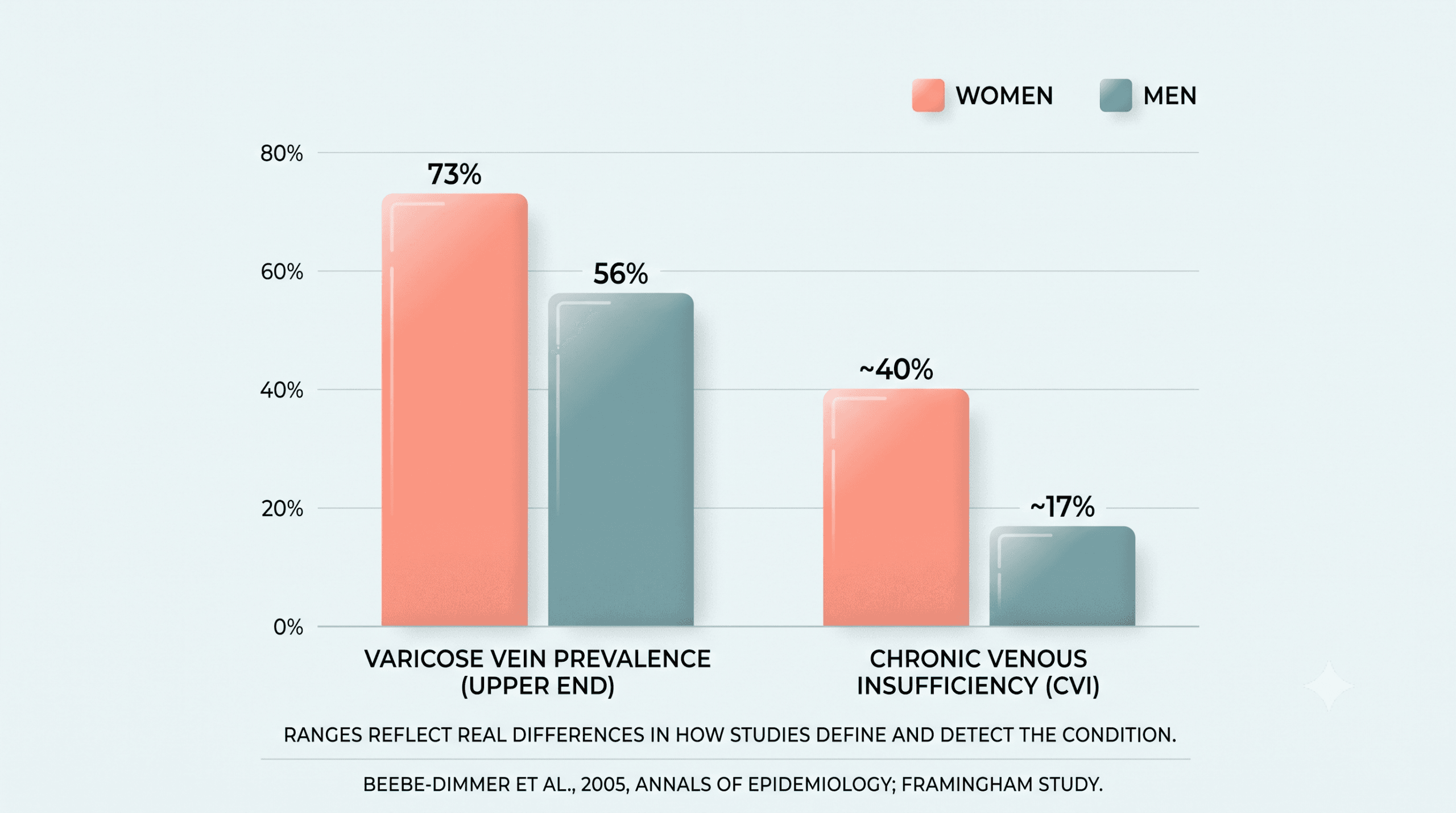
A comprehensive 2005 review in Annals of Epidemiology pulling together decades of population studies reported varicose-vein prevalence ranging up to roughly 73% in women and 56% in men, with chronic venous insufficiency, the more serious end of the spectrum, affecting up to about 40% of women and 17% of men. The wide ranges reflect real differences in how studies define and detect the condition, but even the low end is high.
A 2011 BMJ Clinical Evidence review puts working figures at prevalence of roughly 25–30% in women and 10–20% in men in Western populations, with a biannual incidence around 3% in women and 2% in men. And the Framingham Study, tracking 3,822 adults, measured annual incidence at 2.6% in women and 1.9% in men, meaning a meaningful slice of the adult population develops new varicose veins every single year.
The takeaway: if you have them, you are in the majority, not the minority.
It’s Not Just A Cosmetic Problem
The most persistent myth about varicose veins is that they’re skin-deep. Mechanically, they’re the opposite.
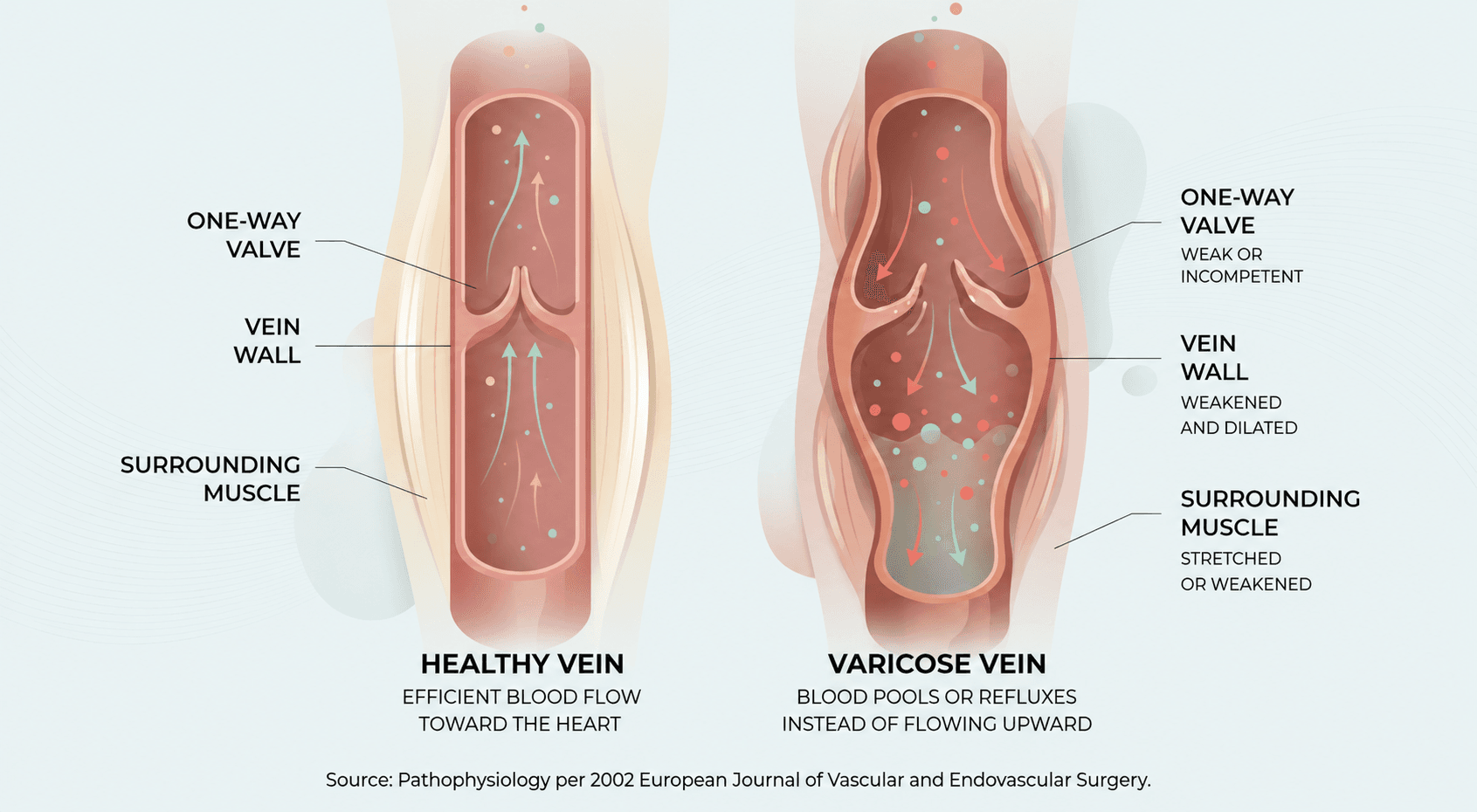
Leg veins carry blood upward against gravity, and they depend on two things to do it: one-way valves that stop blood falling back down, and the squeezing action of surrounding muscles that pushes it along. A 2002 reviewin the European Journal of Vascular and Endovascular Surgery describes the core failure, valves become incompetent and vein walls weaken, allowing blood to pool and vessels to enlarge and twist.
Underneath that is genuine tissue change. A 2006 histopathology review in Angiology describes the microscopic reality: disorganized smooth muscle, altered collagen, and structurally weakened, remodeled vein walls. A 2014 review in the Annals of Vascular Surgery adds the biological drivers, inflammation, matrix remodeling by matrix metalloproteinases, and endothelial dysfunction. And a 2014 biomechanics review in VASA frames it as mechanical failure: raised venous pressure and altered wall properties combine to cause the vessel to give way.
This matters practically because it explains why the visible bulge is a symptom, not the disease. The disease is happening inside the vein wall and its valves, which is also why creams and topicals can’t reach the actual problem.
What Actually Raises Your Risk
Some risk factors you can’t change. Several you can influence.
The Framingham Study identified, in women, associations with obesity, lower physical activity, and higher blood pressure, and found that sedentary behavior of 8 or more hours per day raised risk. That’s a notable finding, because it means both extremes of stillness matter, not just standing.
On standing specifically, an occupational study in the Scandinavian Journal of Work, Environment & Health linked prolonged standing at work with higher likelihood of varicose veins, validating the folk wisdom about jobs that keep you on your feet, though it’s one factor among several.
The Tampere study in the World Journal of Surgery followed middle-aged adults and reported incidence of roughly 19.2 per 1,000 person-years in women and 8.5 in men, tied to age, obesity, family history and standing occupations.
The consistent, established risk factors across this literature: age, female sex, pregnancy, family history, obesity, and prolonged sitting or standing. Genetics and sex you can’t change; weight, activity and how long you stay in one position, you have some control over.
The Good News About Varicose Veins:
If there’s one area where varicose-vein care has genuinely transformed, it’s treatment, and the older assumption that the only option is invasive surgery is out of date.
The landmark evidence is the CLASS trial , published in the New England Journal of Medicine in 2014: a multi-arm randomized controlled trial comparing foam sclerotherapy, endovenous laser ablation, and surgery. All three improved quality of life at six months, with some measures favoring laser ablation and surgery over foam. The practical headline: multiple effective options now exist, several of them minimally invasive.
A 2011 systematic review and meta-analysis in the Journal of Vascular Surgery reached a compatible conclusion, endovenous techniques (laser and radiofrequency ablation) are effective and have largely reshaped first-line treatment. A 2021 best-practice review confirms minimally invasive endovenous treatment as first-line for many patients today.
For milder cases, conservative management comes first. A 2019 American Family Physician review and a 2012 JAMAclinical review both position compression therapy and lifestyle measures as the starting point before procedures are considered.
Choice of treatment depends on the individual and requires assessment, often with duplex ultrasound, by a qualified clinician. This section describes options in general terms, not a recommendation.
The Quality-Of-Life Data
The dismissal of varicose veins as vanity doesn’t survive contact with the outcome research.
The condition can cause aching, heaviness, swelling, itching and, at the more serious end, skin changes and ulceration. Work on patient-reported outcomes, beginning with early methodology published in Quality in Health Care, was developed precisely because clinical signs alone underestimated the impact on daily life.
That impact is real and measurable, which is the strongest argument for taking symptoms seriously rather than waiting. It’s also why prevention and early conservative management are worth the effort, even when the veins look like a cosmetic annoyance.
Supporting Healthy Veins Day To Day
Pulling the evidence together, the modifiable factors point to a consistent set of habits: move regularly rather than staying fixed in one position, avoid long unbroken stretches of both sitting and standing, maintain a healthy weight, elevate the legs when resting, and use compression where a clinician recommends it.
None of these reverse existing varicose veins, the valve and wall changes are structural, but they address the modifiable risk factors the research identifies, and they help with symptoms.
Some people also choose nutritional support as part of that routine. PureHealth Research’s Supplements for Vein Health are formulated with botanicals traditionally associated with circulatory and vein-wall support, intended to complement movement, weight management and compression rather than replace medical care. For anything beyond mild, stable symptoms, and certainly for pain, skin changes or ulceration, the research points firmly toward professional assessment.

Conclusion
Varicose veins affect a large share of adults, are driven by mechanical failure of valves and vein walls rather than anything cosmetic, and respond to a mix of modifiable habits and, where needed, highly effective modern treatments. The two most useful things to know: they’re not your imagination or your vanity, and they’re not untreatable.
Very. A 2005 Annals of Epidemiology review reported prevalence up to roughly 73% in women and 56% in men depending on population and definition, with chronic venous insufficiency affecting up to about 40% of women and 17% of men.
A mechanical failure inside the vein: one-way valves become incompetent and vein walls weaken, allowing blood to pool and vessels to enlarge. Underlying tissue changes include altered collagen, smooth-muscle disorganization and inflammation.
No. They can cause aching, heaviness, swelling, itching and, in more advanced disease, skin changes and ulceration. Outcome research shows a measurable impact on quality of life.
Both are associated with higher risk. The Framingham study linked sedentary time of 8+ hours a day to higher incidence, and occupational research links prolonged standing to greater likelihood of varicose veins.
Yes. A landmark 2014 randomized trial (CLASS) found foam sclerotherapy, endovenous laser ablation and surgery all improved quality of life, with minimally invasive endovenous techniques now first-line for many patients.
Established risk factors include older age, female sex, pregnancy, family history, obesity, and prolonged sitting or standing. Some are unchangeable; weight, activity and posture habits are partly within your control.
Lifestyle changes don’t reverse the structural valve and wall damage, but they address modifiable risk factors and can help with symptoms. Persistent or worsening symptoms warrant medical assessment.

Advertisement. This site offers health, wellness, fitness and nutritional information and is designed for educational purposes only. You should not rely on this information as a substitute for, nor does it replace, professional medical advice, diagnosis, or treatment. If you have any concerns or questions about your health, you should always consult with a physician or other health-care professional. Do not disregard, avoid or delay obtaining medical or health related advice from your health-care professional because of something you may have read on this site. The use of any information provided on this site is solely at your own risk.
Related Articles
Varicose Vein Myths, and What the Research Actually Says
Written by Laura Kraujalyte | July 29, 2026

6 Stages of Varicose Veins: Identifying Symptoms at Each Level
Written by Donatas Leikas | May 11, 2026
Spider Veins on Ankles: Causes, Prevention & Solutions
Written by Donatas Leikas | March 30, 2026

Spider Veins on Face? Common Causes and Treatments
Written by Donatas Leikas | March 22, 2026
Do Spider Veins Itch? Everything You Need to Know
Written by Donatas Leikas | March 7, 2026

How to Cover Spider Veins on Legs? 4 Best Tips
Written by Donatas Leikas | February 18, 2026